SEO vs. GEO: A Complete Guide to AI-Driven SEO for 2026
Key Takeaways |
|
In fact, SEO and GEO are two brilliant inventors in the digital dreamland. SEO drives clicks to your website to build authority, while GEO offers direct answers in AI overviews to the exact questions people are searching for.
Imagine you have a specific problem, and your business has the perfect solution. When you turn to a search engine, you are surprisingly faced with two options. One offers you a direct answer immediately, while the other requires a click and a search through a webpage. Which one would you choose?
That choice illustrates the massive shift between Search Engine Optimization (SEO) and Generative Engine Optimization (GEO) in 2026. Don’t miss a chance to rank—we have the secret AI-Driven recipe right here.
In this guide, we’ve covered every essential part of GEO and SEO to help you dominate the search results. Let’s begin with the historical evolution of SEO.
Do you know about 58.5% clicks were reduced by GEO? We do this to drive clicks on your website
- AI SEO That Works: Boost visibility for search engines & AI.
- Smarter Optimization: SEO for humans and AI.
- Proven Expertise: Grow traffic, leads & revenue.
How SEO Has Evolved?
SEO faced many phases from the infancy era to maturity. Even today, SEO is completely evolving for better website performance. Here is a breakdown for your easy understanding:

The Early Days SEO Story
In the late 1990s, SEO was simple. Search engines focus on keywords to appear and rank based on this criterion. Websites repeated the same keyword again and again to rank higher. It worked, but the content was unreadable and offered little value to users.
The Rise of Backlinks
In the early 2000s, Google introduced backlinks as a ranking factor. Links acted like votes of trust. More links meant higher rankings. This led to link spam, where sites bought or created fake links just to rank, even if their content was poor.
Google Fights Low-Quality Content
Google updates like Panda and Penguin changed everything. Thin content and spammy backlinks started getting penalized. SEO shifted from shortcuts to quality. Helpful, original content began to outperform keyword-stuffed pages.
Mobile Became a Ranking Factor
As mobile usage increased, Google moved to mobile-first indexing. Websites that were slow or not mobile-friendly lost visibility. A smooth mobile experience became essential for SEO success.
User Experience Takes Center Stage
Google started measuring how users interact with websites. Page speed, layout stability, and ease of use now impact rankings. Fast, clean, and user-friendly sites perform better in search results.
Search Intent and AI Shape Modern SEO
Today, SEO focuses on understanding search intent. Google shows results based on what users want, not just keywords. AI-powered search rewards clear, relevant, and human-written content.
Trust and Expertise Matter More Than Ever
Modern SEO values experience, expertise, authority, and trust. Content written by real experts ranks better. Helping users honestly is now the strongest SEO strategy.
Understanding SEO in 2026
SEO remains the backbone of digital visibility. However, the integration of AI is changing how search engines rank content and how businesses optimize their websites. SEO is no longer just about keywords; it’s about relevance, user experience, and intent.
What Is Search Engine Optimization (SEO)
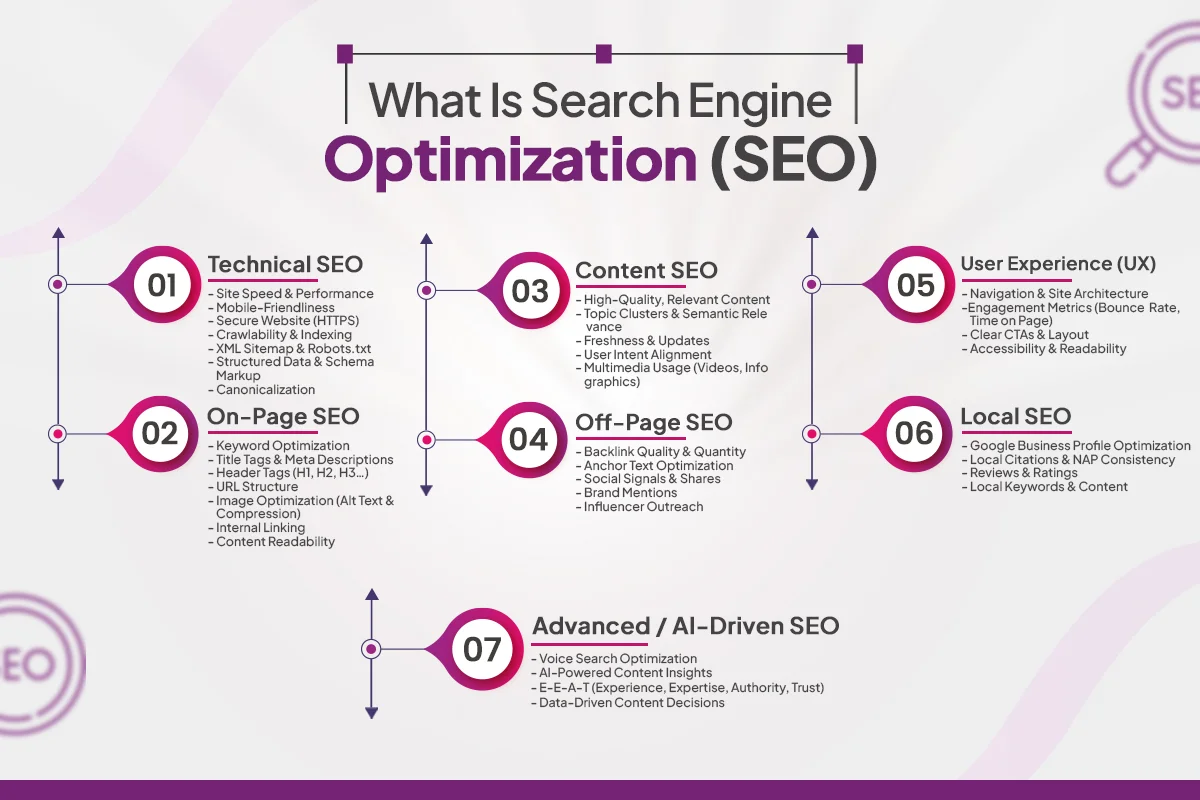
Search Engine Optimization (SEO) is a practice to make a website visible and high-performing in search engine results pages. SEO is a traditional method to rank a website. This includes on-page factors like content quality, meta tags, and internal links, as well as off-page factors like backlinks.
With AI, SEO now focuses on user intent, semantic search, and predictive results. The goal is to make your website helpful and authoritative so both search engines and users find it valuable.
AI Contribution in Traditional SEO
- Automates keyword research and trend analysis
- Enhances content optimization using natural language processing
- Predicts search intent and user behavior patterns
- Improves link-building strategies through AI-powered recommendations
Understanding GEO in 2026
Generative Engine Optimization (GEO) is the next evolution of search optimization. It focuses on AI-driven platforms, which generate content and answers directly for users, often reducing the need for clicks.
What Is Generative Engine Optimization (GEO)

GEO optimizes content for AI-powered engines like Google’s AI Overviews (SGE). Instead of targeting keywords, GEO targets entities, context, and structured data. The goal is to ensure your content is included in AI-generated answers and snippets.
This approach is essential as Zero-Click Searches increase. Users often get answers from AI summaries without visiting your site, so optimizing for GEO ensures your brand still gets visibility and authority.
AI Contribution in GEO
- Identifies relevant entities and context for AI answers
- Optimizes content structure for AI-generated summaries
- Uses LLM optimization strategies for better inclusion in AI snippets
- Monitors AI-driven search trends and predictive user behavior
How Does GEO Differ From SEO
While SEO and GEO aim to increase online visibility, their approaches are different. SEO focuses on driving traffic through ranking on search engines. GEO focuses on getting content included in AI-generated responses, which may reduce direct clicks but increase brand authority.
Targeting Approach
For SEO, focus on keywords, backlinks, and content relevance. These help search engines understand your pages and rank them for the right audience.
For GEO, the focus shifts to entities, context, structured data, and AI snippets. This ensures AI engines recognize your content and include it in generated answers.
Metrics to Track
SEO performance is measured by organic traffic, click-through rates (CTR), and rankings. These indicate how well your content attracts and engages users.
GEO performance is tracked through AI impressions, snippet appearances, and branded searches. These show how often AI engines display your content.
When to Use Each Strategy
- Use SEO for traffic, conversions, and long-term growth
- Use GEO to enhance brand authority and visibility in AI-driven results
- Combining both ensures maximum reach across traditional and AI search platforms
Why Do People Choose Us for SEO?
How to Integrate GEO with SEO
SEO is ideal for building credibility with search engine algorithms. GEO is tremendous for immediate appearance in the AI overview. You need both. How can it be possible? Pause here. Let me tell you something interesting, we asked an SEO expert what you do to balance between SEO and GEO, and he surprised me. You want to know how? Here is a breakdown:
- Map keywords to entities for AI understanding
- Structure content with headings, schema markup, and clear context
- Optimize metadata and summaries for AI snippets
- Monitor Zero-Click Searches and adapt strategies accordingly
- Use LLM optimization strategies to enhance AI-friendly content
Best Practices for AI-Driven SEO and GEO

AI has made SEO and GEO more powerful, but it also requires careful implementation. Following best practices ensures your content ranks well, appears in AI-generated answers, and delivers a great experience for users.
Understanding Technical Practices
Implement Mobile-First Indexing
Most users now access websites via smartphones. Google prioritizes mobile-friendly pages in its rankings. Make sure your site is responsive, loads quickly, and provides a smooth mobile experience. This is especially important for GEO, as AI engines often pull content from mobile-friendly pages first.
Use Structured Data and Schema Markup
Structured data helps search engines and AI better understand your content. Adding schema markup to pages, like articles, products, events, or local businesses, improves the chance of appearing in rich results, knowledge panels, and AI-generated summaries.
Maintain Local Landing Pages and NAP Consistency for GEO
For GEO, local visibility matters. Ensure your business name, address, and phone number (NAP) are consistent across all platforms. Local landing pages targeting city or region-specific queries help AI engines correctly associate your business with a location, boosting chances of appearing in hyper-local searches.
Content Strategies
Apply AI-Assisted Content Optimization
AI tools can analyze readability, keyword usage, and semantic relevance. Use them to make content clear, engaging, and structured. This helps both humans and AI engines understand your pages better.
Develop Hyper-Local Content for GEO
Focus on local topics, events, or customer needs to appear in GEO results. For example, “best coffee shops in Dubai Marina” is a hyper-local query where optimized content can rank in AI summaries.
Create Topic Clusters to Strengthen SEO Authority
Organize content around core topics with related subtopics. Topic clusters improve internal linking, make your website more understandable for search engines, and help AI identify your authority in a particular area.
Continuous Monitoring
Use AI-Powered Analytics Dashboards to Track Performance
AI dashboards provide real-time insights into traffic, rankings, and user engagement. They can identify trends faster than traditional tools, allowing you to respond quickly.
Adjust Campaigns Based on Predictive Insights
AI can predict which content topics or strategies are likely to perform well. Use these insights to optimize content, update pages, or focus on high-potential keywords and entities.
Check Entity Visibility and Snippet Inclusion Regularly
For GEO, it’s important to track which entities (brands, products, people) appear in AI-generated results. Regular monitoring ensures your content is being recognized and used by AI engines effectively.
Challenges and Pitfalls to Avoid
- Over-reliance on AI-generated content without human review
- Ignoring user intent in content strategy
- Local citation inconsistencies and duplicate content
- Misalignment of global SEO and local GEO goals
Future of AI in SEO and GEO
By 2026, AI will dominate search behavior. Trends include:
- Voice search optimization for conversational queries
- Visual Search, optimize images for AI recognition.
- AI-driven SERP features, like featured snippets and summaries
- Hyper-personalization, delivering tailored content at scale
Businesses that combine SEO and GEO strategies while adapting to AI trends will be better positioned for visibility and engagement in the next decade.
Final Thoughts on SEO and GEO
SEO and GEO are complementary strategies for modern digital marketing. SEO drives traffic and conversions, while GEO ensures brand presence in AI-generated results.
A balanced, AI-driven approach ensures businesses stay relevant, visible, and authoritative in 2026. Start auditing your website today and implement DigiDesire’s AI SEO and GEO strategies to future-proof your online presence.
Take Your SEO & GEO to the Next Level
FAQs
SEO primarily fall in on-page, off-page, technical, and local optimization. Top SEO techniques involve keyword research, creating high-quality content, optimizing core web vitals like users' intent, images, loading speed, and mobile-friendliness, fixing broken links, building backlinks, and monitoring performance.
SEO is important for a website to increase visibility, improve user experience, build credibility and authority, and ensure conversion.
Backlink is a vote for your website's credibility from other credible websites. It helps in improving ranking, driving traffic, and building authority.
SEO has evolved since 1990, passed through different phases, but remains a pillar for website authority. Today, SEO isn’t just keyword research; it is the practice of optimizing your website for a better user experience. GEO is an evolved form of SEO; it never replaces SEO, but it empowers SEO to adapt an AI-driven optimizing approach in AI algorithms.
Generative engine optimization is a process to optimize content for Google AI overviews, ChatGPT, Claude, and Perplexity. It is an evolved form of traditional SEO into AI-driven SEO. GEO enables your website to appear in AI searches, which driving shift in users' search. Now, people are shifting to AI search engines instead of questioning search engines.
An AI overview is an AI-powered summary of answers people search for in search engines. An AI overview synthesizes content from different sources and answers questions shortly with citations. According to the 2025 updates, an AI overview reduces clicks by 34.5% to 58.5%. It is increasing day by day.
To improve visibility in Google overviews:
- Answer questions clearly and quickly – put the main point at the top.
- Use structured headings and lists – make it easy to scan.
- Cover the topic fully – provide concise, relevant details Google can pull.
- Build trust – cite sources, include examples, and show expertise.
- Keep content updated – fresh information gets noticed.
- Long-tail, Question-based questions - provide direct answers.
Table of Contents
Categories
Featured Posts
-

Essential Website KPIs: Web Development Company in Dubai Insights
March 15, 2026 -
Agency vs. Freelancer: Finding the Right Web Development Services in Dubai for Your New Venture
March 14, 2026 -
AI Ads in Dubai: Smart Strategy or Risky Move for Revenue Growth?
March 13, 2026 -
Why Are Digital Marketing Trends Shifting Fast?
March 12, 2026 -
Proven Tactics for Improving Your Google Ads Quality Score
March 11, 2026