Culturally Intelligent SM Marketing: Navigating Ramadan & Eid in UAE, 2026
KEY TAKEAWAYS
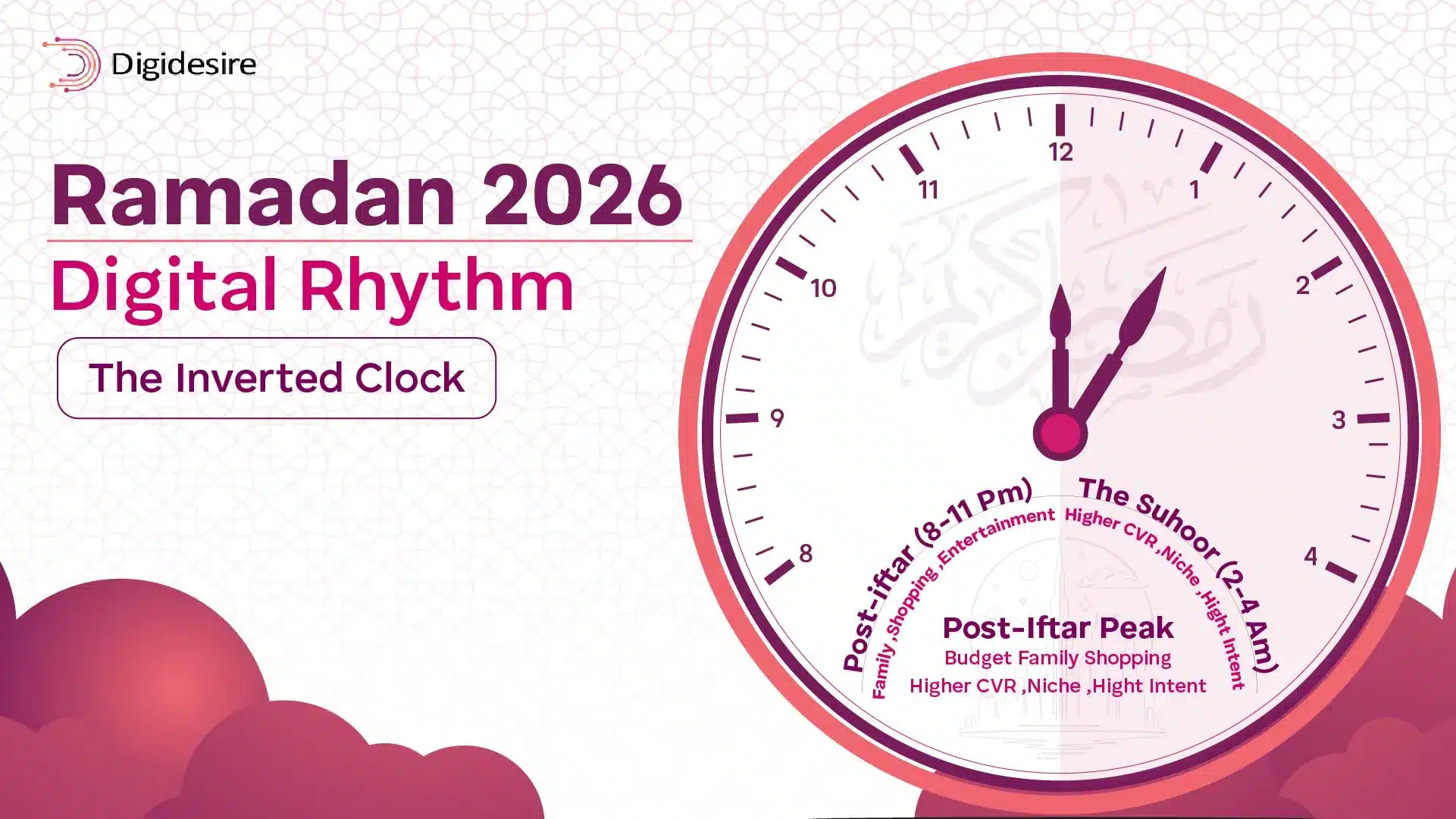
Ramadan 2026 is a winter Ramadan—milder temperatures and earlier sunsets create a leisurely four-hour Post-Iftar engagement window (8-11 PM GST) and a high-intent Suhoor niche (2-4 AM GST).
The Three Phases of Ramadan Marketing:
- Preparation (Feb 4-17): Recipe content, gift guides, charity announcements. 20% budget.
- Reflection (Feb 18-Mar 10): Values-driven storytelling, CSR, employee spotlights. 30% budget.
- Anticipation (Mar 11-19): Eid lookbooks, last-minute gifts, celebration planning. 50% budget.
Platform-Specific Execution: Instagram/TikTok for Reels (Post-Iftar), WhatsApp for VIP conversations (Suhoor), LinkedIn for CSR/thought leadership, Facebook for hyper-local community.
Arabic-First, English-Second: Hero creative must be conceived in Arabic. English is for subtitles and secondary audiences. This is not accommodation; this is respect.
Charity with Transparency: Partner with verified UAE organizations. Communicate impact specifically. Update progress weekly.
Two Eids, Two Voices: Eid Al-Fitr = gifting, celebration, joy. Eid Al-Adha = gratitude, sacrifice, community.
In Dubai, Ramadan does not merely change social media consumption—it inverts it.
During Ramadan in the UAE, daytime social media engagement drops sharply. The Post-Iftar window (8-11 PM) becomes the new peak. The Suhoor window (2-4 AM) emerges as a high-intent niche opportunity. Brands that continue broadcasting during daylight hours don’t just underperform; they disappear entirely. Brands that align with the inverted clock don’t just stay visible; they become essential.
Yet most brands approach Ramadan as a series of isolated “Ramadan Kareem” graphics sprinkled across a 30-day calendar. They treat the holy month as a content obligation rather than a strategic opportunity. They miss the distinct behavioral phases. They miss the two critical engagement windows that define 2026. And they miss the fact that Ramadan is not one audience, but many, each active at different hours, on different platforms, with different intentions.
This guide provides the 2026 framework for navigating Dubai’s most important cultural month with authority and impact. It is not a list of generic tips. It is an hour-specific, platform-by-platform, phase-based execution framework.
Ramadan 2026 is expected to begin on Feb 19, subject to moon sighting. Your Preparation Phase starts now.
Part 1: The 2026 Ramadan Digital Rhythm
Why Ramadan 2026 Is Different: The Winter Holy Month
For the first time in decades, Ramadan arrives in late winter. This is not a minor meteorological detail; it fundamentally shifts consumer behavior.
- Milder temperatures (16°C–28°C) shift the focus from physical endurance to spiritual depth. Evening outdoor gatherings—Iftar tents, Ramadan markets, beachside Suhoor—drive real-world social sharing that Summer Ramadan cannot replicate.
- Earlier sunset times (approx. 6:30 PM GST) extend the Post-Iftar window. Where Summer Ramadan crowds 8-11 PM into three intense hours, Winter Ramadan offers a leisurely four-hour engagement corridor.
- School remains in session. Unlike Summer Ramadan, children are attending classes, creating distinct evening family viewing habits.
The result: A Ramadan that is more social, more shareable, and more strategically complex than any in recent memory.
The Two Critical Engagement Windows
Window | Time (GST) | Consumer Mindset | Brand Opportunity |
Post-Iftar Peak | 8:00 PM – 11:00 PM | Energized, family-oriented, receptive to entertainment & shopping | Primary content deployment. Allocate 60% of the weekly budget here. |
Suhoor Engagement | 2:00 AM – 4:00 AM | Reflective, late-night planners, night-shift workers, crypto/Web3 communities | Niche high-intent window. 40% higher CVR for meal delivery, e-learning, and financial services. |
24-Hour Ramadan Engagement Heat Map
Time Block | Engagement Level | Consumer Behavior | Recommended Content |
6:00 AM – 4:00 PM | Very Low | Fasting, work, school, rest | Scheduled posts only; no active engagement |
4:00 PM – 7:00 PM | Rising | Iftar preparation, grocery runs, commuting | Recipe content, “What’s on your Iftar table?”, countdown stories |
7:00 PM – 8:00 PM | Iftar Break | Breaking fast, family prayer | Pause all posting. Respect the moment. |
8:00 PM – 11:00 PM | PEAK | Entertainment, shopping, family time | Reels, TikTok, Instagram Shopping, Facebook community |
11:00 PM – 2:00 AM | Moderate | Taraweeh prayer, winding down | Storytelling, longer-form video, community discussions |
2:00 AM – 4:00 AM | SUHOOR PEAK | Pre-dawn meal, night workers, planners | WhatsApp broadcasts, Telegram communities, high-intent offers |
4:00 AM – 6:00 AM | Declining | Fajr prayer, preparing for sleep | Wrapping up, schedule next day’s posts |
This heat map is your weekly rhythm. Print it. Distribute it to your team. Treat it as your Ramadan operating schedule.
Turn This Heat Map Into Revenue
Part 2: The Three Phases of Ramadan Marketing

Ramadan is not a single, 30-day homogeneous period. It is three distinct consumer psychology phases, each requiring different content, tone, and budget allocation.
Your 30-Day Narrative Arc
Phase | Dates (2026) | Consumer Mindset | Content Focus | Budget Allocation |
Phase 1: Preparation | Feb 4 – Feb 17 | Planning Iftars, gift shopping, and meal prep | Recipe videos, Iftar menu reveals, gift guides, charity announcements | 20% |
Phase 2: Reflection | Feb 18 – Mar 10 | Spiritual focus, reduced work intensity | Values-driven storytelling, CSR partnerships, employee spotlights, and gratitude posts | 30% |
Phase 3: Anticipation | Mar 11 – Mar 19 | Eid preparation, last-minute gifting | Eid lookbooks, gift guides under AED, celebration planning, countdowns | 50% |
Phase 1: Preparation
Consumer Behavior:
- Meal planning and grocery shopping dominate.
- Gift research begins (perfumes, electronics, fashion).
- Charity decisions are made (who to support, how much to give).
Content Pillars:
Pillar | Example Post Idea |
Recipes | “Your 30-minute Iftar menu for busy weeknights.” |
Iftar Table | “5 ways to style your Iftar table for any budget..” |
Gift Guides | “What to bring when invited to Iftar.” |
Charity | “Meet the UAE organizations we’re supporting this Ramadan.” |
Platform Priority:
- Instagram Reels: Recipe videos, table styling tutorials.
- Facebook Events: Iftar gathering planning, community iftars.
- Pinterest (if relevant): Visual meal planning boards.
Phase 2: Reflection
Consumer Behavior:
- Reduced daytime screen time, increased evening engagement.
- Spiritual deepening; content should mirror this inward focus.
- Skepticism toward aggressive sales messaging intensifies.
Content Pillars:
Pillar | Example Post Idea |
Gratitude | “What we’re grateful for this Ramadan.” |
Patience | “How our team stays productive while fasting.” |
Employee Stories | “Meet [Name]. During Ramadan, we work with her to schedule physically demanding tasks in the morning and shift administrative work to the afternoon—a small adjustment that makes a big difference.” |
Charity Impact | “Week 1 update: 500 meals delivered. Here’s where.” |
Platform Priority:
- LinkedIn: Corporate values, employee spotlights, CSR announcements.
- Instagram: Visual storytelling, emotional micro-narratives.
- TikTok: “Day in the life fasting” content, Iftar prep ASMR.
Tone Guide:
- Use first-person plural (“we,” “our”).
- Avoid superlatives (“best,” “amazing,” “incredible”).
- Lead with questions, not declarations.
Phase 3: Anticipation
Consumer Behavior:
- Eid shopping begins in earnest.
- Last-minute gifting panic sets in.
- Celebration logistics (restaurant bookings, staycations) are finalized.
Content Pillars:
Pillar | Example Post Idea |
Eid Lookbooks | “What to wear for Eid prayers and family visits.” |
Gift Guides | “Last-minute Eid gifts, delivered tomorrow—thoughtfully priced for every recipient tier.“ |
Restaurant Bookings | “Still looking for Eid lunch? These 5 spots have tables.” |
Staycations | “24 hours in [Hotel]: Your Eid escape plan.” |
Countdowns | “3 days until Eid. Are you ready?” |
Platform Priority:
- Instagram Shopping: Tag products directly in Eid outfit posts.
- TikTok Shop: “Eid fit check” trends, unboxing videos.
- WhatsApp Business: VIP broadcast lists with early access codes.
Urgency Without Aggression:
*”Still looking for the perfect Eid gift? We’ve curated 10 ideas for every budget—all available for same-day delivery in Dubai.”*
Not:
“LAST CHANCE! Eid sale ends TOMORROW! DON’T MISS OUT!”
Part 3: Platform-Specific Execution

Generic “post on Instagram” advice is not a strategy. This is.
Instagram & TikTok
Element | Recommendation |
Optimal Times | Post-Iftar: 8:30-10:30 PM GST |
Suhoor: 2:30-3:30 AM GST (niche audiences only) | |
Peak Days | Wednesday, Saturday, Sunday |
Content Formats | Reels (recipes, table settings, evening routines), Stories (polls, Q&A, behind-the-scenes) |
Creative Guidelines | Silent-first with Arabic/English subtitles; warm lighting; cozy evening aesthetics; avoid daytime food imagery |
Commerce | Tag products directly in Reels; TikTok Shop for impulse purchases |
UGC Campaigns | #RamadanInUAE, #RamadanKareem, #رمضان_2026, #Ramadan2026, #RamadanInDubai, #DubaiIftar, #Suhoor |
Reel Length Recommendation:
- Recipe content: 15-30 seconds (jump cuts, no talking head).
- Storytelling: 45-60 seconds (slow pace, emotional arc).
- Eid fashion: 10-15 seconds (quick cuts, music-driven).
WhatsApp Business
Element | Recommendation |
Optimal Times | 8:00-10:00 PM (Post-Iftar, high open rates) |
2:00-4:00 AM (Suhoor, low competition, high intent) | |
Use Cases | VIP broadcast lists, order confirmations, personalized Iftar invitations, charity donation links |
Content Types | Text + image, short video clips (15 sec max), voice notes in Khaleeji dialect |
Automation | ManyChat flows for lead capture; human agents for high-intent conversations |
Frequency Cap | Maximum 2 broadcasts per week. Ramadan audiences are protective of their private channels. |
WhatsApp is not Instagram. Do not treat it as a broadcast version of your feed. It is a conversation channel. Use it accordingly.
Element | Recommendation |
Optimal Times | 9:00 AM – 2:00 PM (lunch break) |
9:00-11:00 PM (Post-Iftar, family browsing) | |
Peak Days | Tuesday – Thursday |
Content Formats | Community group discussions, event promotions, local business spotlights, photo albums |
Creative Guidelines | Family-oriented, warm tones, community-focused; avoid overly polished corporate aesthetics |
Groups Strategy | Partner with existing UAE community group admins for organic reach |
Facebook’s Ramadan superpower is the local community. While Instagram chases viral reach, Facebook enables neighborhood-level connection. Use it.
Element | Recommendation |
Optimal Times | 8:00-10:00 AM (morning commute) |
9:00-11:00 PM (professionals unwinding) | |
Peak Days | Tuesday – Thursday |
Content Formats | CSR announcements, employee Ramadan reflections, flexible work policies, thought leadership |
Tone | Reflective, grateful, purpose-driven |
Hashtags | #Ramadan, #UAE, #Leadership, #CSR |
LinkedIn during Ramadan is not about sales. It is about organizational character. Use it to signal that your company understands and respects the cultural moment.
X (Twitter)
Element | Recommendation |
Optimal Times | 7:00-9:00 PM (real-time Iftar moments) |
Content Formats | Live updates, community conversations, hashtag participation |
Hashtags | #Ramadan2026, #DubaiIftar, #RamadanInUAE, #NowInDubai |
Tone | Conversational, light, community-building |
X is your real-time engagement layer. Use it to participate in existing conversations, not to broadcast your own.
Part 4: The Bilingual AI Mandate
Beyond Translation: The 2026 Bilingual Standard
Most brands treat bilingual content as translation after the fact. An English post is written, then handed to a translator for the Arabic version. The Arabic arrives days later, often awkward, always secondary.
In 2026, this is no longer sufficient.
The 2026 Standard: Arabic-First, English-Second
- Hero creative, the video script, the headline, and the primary visual must be conceived, written, and produced in Arabic.
- English is for subtitles, secondary copy, and expat audiences who do not consume Arabic media.
- Instagram’s AI serves Arabic audio to Emirati users; English captions are secondary signals.
- TikTok’s algorithm prioritizes native Arabic voiceovers for users in the region.
This is not an accommodation. This is respect. It signals that your brand sees the UAE not as a market to be translated for, but as a home to be spoken to.
How to Execute Arabic-First Content
- Script in Arabic.
Work with native Arabic copywriters who understand Khaleeji dialect and cultural nuance. Do not write in English and translate. Write in Arabic from conception. - Record voiceover in Khaleeji dialect.
Modern Standard Arabic (MSA) is formal, official, and distant. Khaleeji is intimate, trusted, and emotionally resonant. Choose a dialect based on your audience. - Add English subtitles.
Burn them into the video frame. Do not rely on Instagram’s auto-captioning for Arabic content; it frequently mistranslates. - Test both languages.
Run A/B tests on the same creative with Arabic audio/English subs vs. English audio/Arabic subs. Measure engagement rate by audience segment.
AI Tools for Bilingual Efficiency
Tool | Function | Limitation |
CapCut | Auto-generate Arabic + English subtitles | Requires manual review; Khaleeji dialect accuracy is ~70% |
Descript | Edit video by editing text; auto-captioning | MSA only; not reliable for dialect |
Jasper / Copy.ai | Generate ad copy variations in both languages | Requires human editing for cultural nuance |
OpusClip | Repurpose long-form Arabic content into short-form English Reels | Good for volume; weak on tonal consistency |
AI accelerates production. It does not replace cultural intelligence. Always have a native speaker review AI-generated Arabic content before publishing.
See How We Do It
Part 5: The Charity Imperative
Ramadan Giving: Authentic Partnerships, Not Performative Philanthropy
Ramadan is the most giving month in the UAE. The evidence is everywhere: Careem’s in-app donations service, Right Click, recorded a 240% spike in giving during Ramadan 2025. Meanwhile, the Fathers’ Endowment campaign alone raised over AED 3.3 billion from more than 160,000 contributors. Consumers are not just open to charitable messaging; they actively seek it, and they are using digital channels to give at unprecedented scale.
But they are also highly attuned to performative philanthropy. Brands that announce partnerships without transparency, or that use charity as a thin sales veil, are punished swiftly in sentiment data.
Do’s and Don’ts
✅ Do | ❌ Don’t |
Partner with verified UAE charities (Red Crescent, Dubai Charity Association, Beit Al Khair) | Announce a partnership without execution details |
Communicate impact in specific, measurable terms: “Your purchase provided 1,000 meals.” | Use tragedy or suffering as a marketing spectacle |
Share beneficiary stories with dignity and explicit consent | Launch a campaign without a clear donation allocation framework |
Create a dedicated landing page for your initiative | Bury the charity link in a bio or “link in profile.” |
Update progress weekly during Ramadan | Post once and go silent |
Campaign Architecture
The Formula:
“For every [action] between [date] and [date], we donate [specific impact] to [verified charity]. Track our progress here [link].”
Example:
“For every Iftar meal ordered via our app between Feb 18 and Mar 19, we donate one meal to Beit Al Khair. Help us reach 10,000 meals. Track our daily progress at [link].”
Why this works:
- Transparency: The user knows exactly what their action achieves.
- Progress tracking: Creates a narrative arc across the month.
- Verification: Named charity signals institutional trust.
Part 6: Eid Al-Fitr & Eid Al-Adha – Two Eids, Two Voices
Most brands treat Eid Al-Fitr and Eid Al-Adha as interchangeable. They are not. One is a celebration of achievement. The other is a reminder of sacrifice.
Eid Al-Fitr (March 20-22) – The Gifting Eid
Element | Strategy |
Consumer Intent | Celebration, gift-giving, new clothes, family gatherings |
Tone | Joyful, vibrant, generous, relieved |
Content Focus | Gift guides, Eid outfits, restaurant bookings, last-minute offers, “first Eid without fasting.” |
Platform Priority | Instagram Shopping, TikTok Shop, Facebook Events |
Creative Palette | Bright, celebratory; golds, greens, whites |
Campaign Example:
“You made it. After 30 days, it’s time to celebrate. Discover our Eid collection—delivered to your door by morning.”
Eid Al-Adha (May 27-29) follows a completely different emotional arc—focused on sacrifice, gratitude, and community. We will publish a dedicated guide for Eid Al-Adha closer to the date.
The Creative Differentiation Rule
“A fashion retailer should push ‘Eid outfits’ in March and ‘thoughtful gifts for your driver’ in May. Same brand, completely different voice.”
If your Eid Al-Fitr and Eid Al-Adha campaigns could be swapped without detection, you have failed at cultural intelligence.
Part 7: Measuring Ramadan Success
Vanity metrics do not fast during Ramadan. They continue to inflate reports and obscure the truth. You must measure differently.
Beyond Vanity Metrics: Ramadan 2026 KPIs
Metric | Why It Matters | Benchmark Goal |
Post-Iftar Engagement Rate | Measures content resonance during the peak window | +30% vs. non-Ramadan average |
Suhoor Conversion Rate | Tracks high-intent niche audience | 40% higher than daytime CVR |
Charity Campaign Participation | Direct impact metric; brand trust signal | Set an internal goal based on the campaign scope |
WhatsApp Forward Rate | Indicates trusted, shareable content | Track against pre-Ramadan baseline |
UGC Volume | Earned media from #RamadanWith[Brand] | 100+ pieces per campaign |
Sentiment Analysis | Measures cultural appropriateness | 90%+ positive/neutral |
Share of Voice | Against key Ramadan hashtags | +15% vs. pre-Ramadan |
Setting Up Your Ramadan Dashboard
- Create custom UTMs for all Ramadan-specific content.
- Benchmark pre-Ramadan engagement rates by platform (last 30 days).
- Tag content by phase (Preparation, Reflection, Anticipation) in your analytics tool.
- Monitor sentiment daily. A single culturally insensitive post can erase 30 days of goodwill.
Conclusion: Your Ramadan 2026 Guide
Ramadan is not an interruption to your content calendar. It is not a month to “get through” until normal marketing resumes. It is the most valuable chapter of your 2026 strategy.
Learn: How does our social media marketing agency in Dubai take a strategic move?
The brands that win Ramadan 2026 will not be those with the largest budgets. They will not be those with the most aggressive sales tactics. They will be those with the deepest cultural intelligence.
Your 7-Day Action Plan:
- Block your calendar today. Your Preparation Phase should have started Feb 4—if you haven’t begun, your Ramadan campaign is already behind. Accelerate now.
- Audit your creative assets. Do you have an Arabic-first video? Silent-first Reels? Khaleeji voiceover talent booked?
- Secure charity partnerships. Verified UAE organizations require lead time for approval. Start now.
- Train your community managers. Ensure your team understands the weight of Post-Iftar and Suhoor windows. No daytime posting. No aggressive DMs.
- Allocate budget by phase. 20% Preparation, 30% Reflection, 50% Anticipation. Adjust based on real-time performance.
- Prepare your Eid transition. The tone shift from Reflection (March 10) to Anticipation (March 11) must be seamless.
- Set your measurement framework. Vanity metrics off. Value metrics on.
The inverted clock is ticking. Your audience is waiting. They are hungry, not just for food, but for connection, meaning, and brands that understand who they are and what this month means.
Speak to them accordingly.
Execute Ramadan 2026 With Confidence
FAQs
Begin your Preparation Phase content 2 weeks before Ramadan starts (approx. Feb 4). This is when consumers actively search for Iftar ideas, meal plans, and gift inspiration. Brands that launch on Day 1 of Ramadan have already lost the pre-engagement battle.
The Post-Iftar window (8:00 PM – 11:00 PM GST) delivers the highest engagement volume. This is when families are gathered, screens are open, and purchase intent peaks. A secondary niche audience is active during Suhoor (2:00 AM – 4:00 AM GST) —smaller in volume, but significantly higher in conversion intent. Avoid daytime hours entirely.
Yes, but shift budgets to evening hours. CPC often drops 15-20% during the daytime due to lower competition, but conversion rates also plummet. The Post-Iftar window delivers the optimal efficiency balance. Allocate 60% of your weekly budget to the 8-11 PM window, 20% to Suhoor, and 20% to daytime (primarily for awareness objectives).
Yes, with an Arabic-First approach. Hero creative—video scripts, headlines, primary visuals—must be conceived and produced in Arabic. English subtitles or secondary copy follow. This is not translation; this is cultural respect. Instagram's AI serves Arabic audio to Emirati users; English captions are secondary. Brands that lead with English and add Arabic as an afterthought signal that the local audience is an accommodation, not a priority.
(1) Posting during daytime hours. Your content is invisible, and your ads are wasted. (2) Generic "Ramadan Kareem" graphics. A single graphic with no substantive content behind it is worse than silence. (3) Announcing charity partnerships without transparency. If you don't name the charity, specify the donation amount, and track impact, consumers will assume you are performative. (4) Continuing aggressive sales messaging during the Reflection Phase. The first 10 days of Ramadan are not for "flash sales." Read the room.
Table of Contents
Categories
Featured Posts
-

Proven Tactics for Improving Your Google Ads Quality Score
March 11, 2026 -
Understanding Current Digital Marketing Industry Trends
March 9, 2026 -
The Rise of Social Commerce in Dubai: Closing Sales Without Landing Pages
March 8, 2026 -
10 Questions to Ask Your Dubai Mobile App Development Partner
March 7, 2026 -
Learn How to Start UAE E-commerce - Digital Marketing (2026)
March 6, 2026