Dubai is a global crossroads. With over 200 nationalities, supreme smartphone penetration, and a digitally fluent population expecting excellence, designing a mobile app here is a unique challenge. In 2026, Mobile App UX Design Dubai has evolved beyond usability. It’s about cultural intelligence, performance under scrutiny, and emotional connection. A beautiful app that loads slowly or misunderstands local norms isn’t just poorly designed; it’s a business risk. This guide explores the user-centered design Dubai principles, cultural nuances, and technical essentials that define winning UX in the UAE’s competitive digital ecosystem.
Dubai’s population is a blend of Emiratis, Western and Arab expatriates, and South Asian professionals. Each group brings distinct digital behaviors. While Arabic is official, English is a lingua franca. However, segments are more comfortable in Hindi, Urdu, or Tagalog. A successful app communicates naturally across these linguistic boundaries, a cornerstone of effective multilingual app UI design.
Digital literacy is high, but impatience is higher. Users compare your app to global giants like Amazon and local champions like Careem. Expectations are sky-high; tolerance for friction is minuscule. High spending power meets digital willingness, but every dirham spent is critically evaluated against the experience received.
With smartphone penetration exceeding 90%, specific behavioral patterns emerge:
Designing flows that match this reality isn’t just helpful, it’s essential for user-friendly app development.
True localization understands that culture influences technology interaction.
In Dubai’s fast-paced environment, speed is UX. Research indicates 53% of users abandon apps taking over 3 seconds to load.
For example, a leading Dubai-based luxury retailer found that improving their Largest Contentful Paint (LCP) by 0.8 seconds directly correlated with a 12% increase in mobile conversion rates during peak shopping hours. This underscores that in the UAE market, performance optimization is not a back-end task but a direct revenue driver, necessitating tools like Google’s Lighthouse and testing on local Etisalat/du networks throughout the development cycle.
UAE digital accessibility regulations are strong. Accessible design benefits everyone:
Rapid digital adoption makes establishing trust paramount.
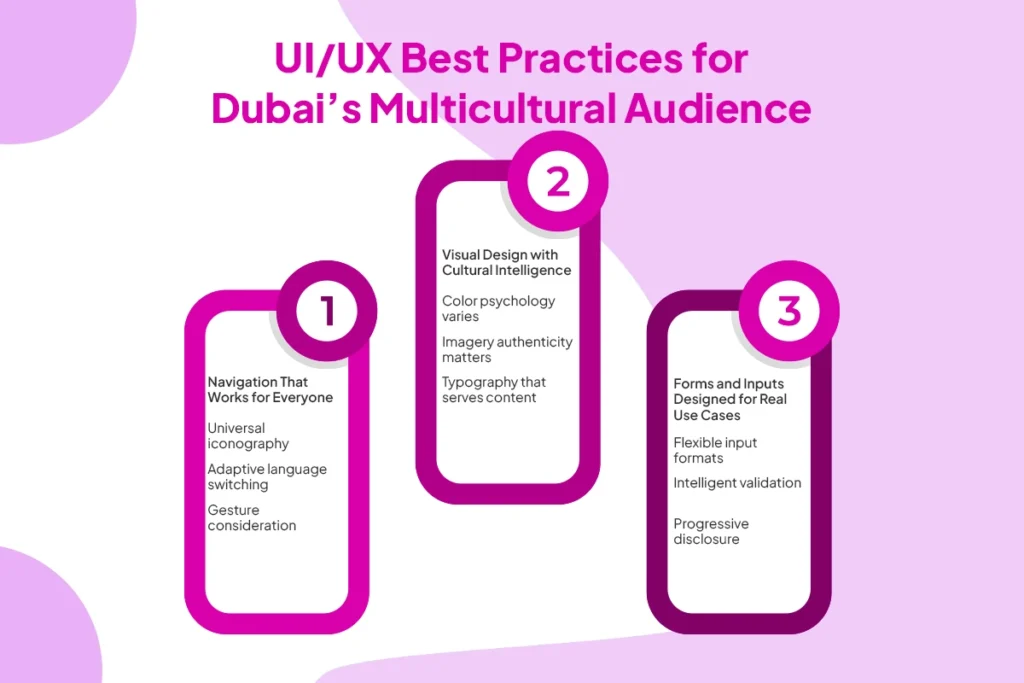
Balance universal design with local adaptations:
Optimize for Dubai’s specific needs:
Consider the challenge faced by a Dubai-based luxury tailoring house. Their clientele, high-net-worth individuals accustomed to premium service, expected a digital experience that mirrored their in-store bespoke service. Their initial website failed to convert because it used generic imagery and a cumbersome booking flow.
The UX solution was hyper-localized and user-centered:
The outcome was a digital storefront that felt authentically Dubai, resulting in a measurable increase in qualified appointment bookings and establishing a stronger digital brand presence. This example illustrates that for Dubai’s discerning users, UX is the silent ambassador of your brand’s quality and a critical component of Dubai app development trends.
Choosing the right UX approach can make or break your product’s success. Whether you’re building an in-house team or partnering with a premium mobile app development company, like DigiDesire in Dubai, the goal is the same: delivering smooth, user-first experiences. The key is to ensure these essential UX capabilities are fully covered, so your app not only looks great but also works effortlessly for your users.
The team must understand subtle nuances: which design patterns resonate with different demographics, which features are expected based on competitor offerings, and how to navigate the unique aspects of UAE digital culture. For instance, they should know that a “guest checkout” option can significantly reduce abandonment in a market wary of lengthy sign-ups.
The UAE’s digital landscape includes specific regulations around data privacy (PDPL), content, and accessibility. The responsible team must proactively ensure your app’s UX complies while maintaining a seamless experience, turning compliance into a trust-building feature rather than a constraint.
Effective UX requires testing with participants who reflect your actual target audience. The right team can recruit appropriate testers, conduct sessions in relevant languages, and, most importantly, interpret feedback through a local cultural lens to uncover true insights, not just surface-level opinions.
Post-launch, continuous improvement is vital. The team should monitor how real users in the UAE interact with your app, identify context-specific pain points (e.g., drop-offs during Arabic checkout), and implement targeted enhancements that drive engagement and retention in this market.

In Dubai’s crowded app marketplace, superior UX is your most powerful differentiator. An app that feels made for Dubai, that understands its people and delights them at every touchpoint, doesn’t just acquire users, it retains them.
As we move through 2026, the lines between technology and humanity will blur further. The winners will design not just for screens, but for people. If you are looking to navigate this landscape, partnering with experts like DigiDesire ensures your app meets international standards while catering to the specific needs of this unique market.



Plot No. 75-0, Empire Heights Tower A, Business Bay, Dubai
Melbourne CBD 440 Collins St, Melbourne VIC 3000, Australia
Office # 701, 7th Floor, Razi Tower, BC-13, Block 9, Clifton, Karachi.
Plot No. 75-0, Empire Heights Tower A, Business Bay, Dubai
Melbourne CBD 440 Collins St, Melbourne VIC 3000, Australia
Office # 701, 7th Floor, Razi Tower, BC-13, Block 9, Clifton, Karachi.


