Generative Engine Optimization for AI Search Success
Key Takeaways Generative Engine Optimization focuses on visibility inside AI-generated answers. GEO vs SEO shows a shift from ranking pages to being cited in responses. AI answer engines prioritize clarity, structure, and authority. Comprehensive content performs better than thin articles. Question-based formatting improves AI extraction. Authority, depth, and consistency are major Generative AI ranking factors. The future of search optimization requires combining SEO and GEO. Search is not what it used to be. People are no longer just typing short keywords into Google. They are asking full questions inside ChatGPT, Gemini, and other generative search engines. Instead of showing a list of blue links, these platforms generate direct answers. This shift has created a new opportunity. It is called Generative Engine Optimization. If you want your brand to stay visible in the age of AI answer engines, you need to understand how GEO works. This guide will explain everything simply and practically. 35% More Dubai’s Brand Mentions in AI-Generated Answers — Is Yours Included? Our experts help your Dubai brand get cited in AI-generated answers, boosting visibility, credibility, and long-term recognition Unlock Your Dubai SEO Potential What Is Generative Engine Optimization Generative Engine Optimization, or GEO, is the process of optimizing your content so it can appear inside AI-generated responses. Unlike traditional SEO, which focuses on ranking web pages, GEO helps AI models understand and trust your content. When someone asks an AI tool a question, the system does not simply show links. It reads and synthesizes information from multiple sources. Then it generates a structured answer. If your content is clear, accurate, and authoritative, it may become part of that response. That is the core idea behind AI search optimization. Instead of chasing clicks, you are optimizing for inclusion and reference. GEO is not a replacement for SEO. It is an evolution. Traditional SEO still matters. But now, you also need to optimize for AI models that interpret meaning rather than just keywords. How AI Answer Engines Work To build a strong GEO strategy, you need to understand how AI search algorithms function. First, AI systems understand natural language. They do not rely only on exact keyword matches. They interpret context, intent, and phrasing. For example, “What is generative engine optimization?” “EEAT role in AEO” and “Explain GEO in simple words” mean nearly the same thing to an AI model. Second, generative search engines synthesize information. They combine insights from different sources to create a complete answer. This means your content must be detailed enough to stand alone. Thin or vague articles are less likely to be referenced. Third, AI answer engines prioritize trust. They favor sources that demonstrate expertise, consistency, and factual accuracy. This is where Generative AI SEO overlaps with authority building. If your content clearly explains a topic, avoids exaggeration, and stays updated, it has a stronger chance of being included in AI responses. GEO vs SEO: Understanding the Shift Many people ask about SEO vs. GEO. The difference is simple but important. SEO focuses on ranking web pages in search engine results. The goal is to earn clicks and traffic. It relies on keywords, backlinks, technical optimization, and user engagement signals. GEO, on the other hand, focuses on becoming a trusted source for AI systems. The goal is to be cited or referenced in AI-generated answers. Instead of just optimizing metadata and links, you optimize clarity, structure, and depth. SEO is about visibility in search results. GEO is about visibility inside answers. However, they are not competitors. They work together. Strong SEO builds authority and credibility. That authority supports your AI-powered search optimization efforts. In the future of search optimization, businesses will need both. Why Generative Search Engines Matter Generative search engines are growing rapidly. Users prefer direct answers. They want solutions without clicking through multiple pages. AI tools are becoming digital assistants. They summarize information, compare products, explain concepts, and guide decisions. If your content is not optimized for this environment, you risk losing visibility. Learn: If you don’t know how to make effective backlinks for generative engine optimization, explore this guide to GEO Backlink Methods for 2026 This is why Generative engine marketing is gaining attention. Brands now need to think about how their information appears in AI-driven ecosystems. Optimizing for generative search engines is not about gaming algorithms. It is about providing structured, reliable knowledge that AI systems can confidently use. How Dubai Brands Rank with AI? Discover how Dubai businesses are leveraging AI and generative engines to boost visibility and get cited more. Let our experts guide your brand to the top. Talk to an Expert Core Principles of GEO Optimization A strong GEO optimization guide starts with fundamentals. You do not need complicated tactics. You need clarity and depth. The first principle is question-driven content. AI models respond to user queries. If your content directly answers real questions, it becomes easier to extract. Writing in a conversational tone also supports Conversational AI SEO. The second principle is comprehensive coverage. AI systems prefer content that explains a topic fully. Instead of publishing multiple short articles, create detailed guides that explore definitions, examples, benefits, and implementation steps. The third principle is structure. Clear headings, short paragraphs, and logical flow help AI systems understand your content. When you organize information step by step, you improve your chances of being referenced. The fourth principle is accuracy. AI content optimization depends heavily on factual correctness. Outdated or exaggerated claims reduce trust. Always verify your information. When these principles work together, your content becomes more valuable to both users and AI answer engines. How to Optimize for ChatGPT and AI Models If you want to optimize for ChatGPT, focus on simplicity and clarity. Start by defining terms clearly. For example, when explaining Generative Engine Optimization, provide a direct and simple definition before expanding the concept. AI models prefer content that introduces a topic logically. Next, write in natural language. Avoid keyword stuffing. Instead, integrate terms like Generative AI SEO, AI search optimization, and Optimize content
Social Media Marketing Dubai: A 2026 Strategic Framework
Key Takeaways The 2026 Mandate: Stop posting. Start building. Visibility is table stakes; success = community ownership, AI-driven efficiency, and revenue. Platform Ecosystem Model: Assign every platform a specific “job.” Instagram/TikTok = Discovery. WhatsApp = Sales. LinkedIn = Authority. Facebook = Local Community. 4 Pillars of Strategy: AI-Powered Personalization, Authenticity Mandate, Social Commerce, Trust Economy. Audit the weakest pillar first. AI Handles How. Humans Command Why: AI scales efficiency (subtitles, copy variants, predictive analytics). Strategy, nuance, and brand voice remain human. 50/30/20 Content Rule: 50% value, 30% storytelling, 20% promotion. UGC is trusted 3x more than branded ads. Friction Kills Conversion: Social platforms are closed-loop sales channels. Mandatory: Shoppable feeds, TikTok Shop, WhatsApp checkout. Owned Communities > Rented Audiences: Algorithm-dependent feeds are liabilities. WhatsApp/Telegram groups = moats. Measure private group growth, not follower count. Hyper-Localization is Non-Negotiable: Translation ≠ localization. Ramadan themes, National Day narratives, and cultural resonance. Silent-first video = functional law (UAE voice/video restrictions). Align to Behavior, Not Office Hours: Peak consumption: Evenings, weekends, Friday post-prayer (~1 PM). Peak windows: 7-9 AM (Stories/LinkedIn), 12-2 PM (Reels/Facebook), 7-11 PM (TikTok/YouTube). Ramadan Shift (Feb/March 2026): Engagement doubles post-Iftar (8-11 PM). Suhoor (2-4 AM) = niche high-intent. Content themes = community, generosity, family. Vanity Metrics Are Dead: Stop measuring: follower counts, likes, impressions. Start measuring: engagement rate, saves/shares, conversion rate, social ROI, and private group activity rate. PDPL Compliance = Trust Signal: Data privacy is a competitive advantage. Communicate transparency. 2026 Standard Toolkit: Canva Magic Studio, Adobe Firefly, CapCut, OpusClip, Jasper, Copy.ai, Hootsuite, Sprout Social, ManyChat. Telegram = critical for Web3/crypto sectors. Depth Beats Breadth: Master one pillar per quarter. This quarter: shoppable feeds OR 50/30/20 OR 5 micro-influencer partnerships. Micro-Influencers Win: 5k-50k followers, high engagement > celebrity endorsements. Evaluate by UAE engagement rate, not follower count. If You Can’t Connect Activity to a Value Metric, Stop Doing It: Ruthless prioritization = competitive advantage. In 2026, social media marketing in Dubai has completed a fundamental shift. With over 99% of the UAE population active online, spending a global-high average of over 5 hours daily on these platforms, mere visibility is no longer a metric of success. The digital landscape is saturated, sophisticated, and driven by a demand for authentic connection. The old playbook of chasing follower counts and generic engagement is obsolete. Today, success is defined by community ownership, AI-enhanced personalization, and tangible business outcomes. For a boutique in Jumeirah, a fintech startup in DIFC, or a logistics firm in JAFZA, this means moving from simply posting to building an integrated, multi-channel ecosystem that functions as a direct line to your customer, a key revenue driver, and the core of your brand’s community. This framework deconstructs the essential pillars of this new era. It moves beyond listing trends to provide a structured, actionable model for building a social media presence that is not just seen, but valued, trusted, and essential to your audience in Dubai. Need Clarity? Book a 15-minute discovery call with our team. Book a Call with our experts. Part 1: The 2026 Strategic Core–The Integrated Platform Ecosystem Gone are the days of posting the same content everywhere. The 2026 model assigns specific, strategic “jobs” to each platform, creating a seamless customer journey. Fragmented efforts fail; an integrated system wins. The table below outlines the core functions of each major platform in the Dubai market. Treat this as your strategic assignment sheet for social media marketing in Dubai. Platform Primary 2026 “Job” in Dubai Key Content Format & Metric 2026 UAE Reach / Context Instagram & TikTok Discovery & Desire Engine “Silent-first” Reels/Shorts; Social commerce conversion rate Instagram remains the visual powerhouse, with industry reports estimating over 8 million users in the UAE. While TikTok has rapidly grown past 6.5 million users (industry estimate), it is now a core media infrastructure. WhatsApp Business Conversational Commerce Hub Direct service & sales chats; Lead-to-close ratio WhatsApp is the undisputed, non-negotiable communication channel for the UAE market. LinkedIn B2B Authority Platform Industry whitepapers & case studies; Quality of inbound leads LinkedIn is essential for B2B, with membership estimates approaching 10 million professionals. Facebook Hyper-Local Community Builder Local group engagement & targeted ads; Community growth & activity rate Facebook maintains over 9 million users, powering local community discovery. How-To Implementation: Making the Ecosystem WorkUnderstanding the “job” is step one. Step two is creating the workflows that connect them. From Discovery to Deal: A potential client discovers your interior design firm through a TikTok Reel showcasing a project in Dubai Hills. A comment asks for a consultation. Your response should guide them to message your WhatsApp Business number for a portfolio and quote, creating a warm, direct lead. From Authority to Action: You publish a LinkedIn article on commercial real estate trends in DIFC. A reader clicks your profile link to your website, where a chatbot offers to send a detailed market report via email. This captures a high-intent B2B lead, moving them from your professional network to your sales funnel. Part 2: The Four Pillars of Modern Dubai Social Strategy These four pillars form the non-negotiable foundation of every post, campaign, and community interaction in 2026. Pillar 1: AI-Powered Personalization (The Efficiency Layer) AI is not a future concept; it’s a present-day operational necessity for scaling quality. However, its role is one of augmentation, not replacement. How-To Implementation: Deploying AI in Your Dubai Strategy AI transforms guesswork into strategy. To deploy it effectively: For Predictive Analytics: Leverage the AI capabilities within advanced social media management suites. Use them to analyze your historical performance and predict engagement spikes, allowing you to align your content calendar precisely with Dubai’s peak consumption rhythms and major local events like the Dubai Shopping Festival. For Content Optimization: Tools like Jasper or Copy.ai can generate multiple variations of ad copy for A/B testing in seconds. For video, use CapCut or Descript to automatically generate and perfect Arabic and English subtitles, ensuring your “silent-first” content is both accessible and culturally nuanced. The Human Edge: The strategy, the cultural nuance
Business Mobile App Development: The Executive Handbook for Scaling in 2026

Many businesses struggle with fragmented operations, manual coordination, and limited real-time visibility across teams and customers. From a service provider’s perspective, mobile app development addresses these challenges by creating a centralized digital system that connects employees, processes, and customers in one platform. Rather than being a cosmetic upgrade, a well-planned mobile application helps reduce operational inefficiencies, improve communication, and enable data-driven decisions. When aligned with business goals, mobile app development becomes a strategic tool for lowering operational costs, improving customer experience, and supporting sustainable growth in an increasingly competitive digital environment. In 2026, building an app isn’t a vanity project. It is the difference between being a market disruptor and a legacy casualty. Whether you are a startup founder looking to pitch to VCs or an enterprise director aiming to digitize workflows, the decisions you make in the next few months regarding your mobile strategy will define your revenue for the next decade. This guide isn’t just about code; it’s about business logic. We are going to dismantle the complexities of app development, from the gritty details of API integration to the high-level strategy of super app development trends. Is Your Business Ready for Mobile? Don’t start coding until you have the blueprint. Download our “2026 App Readiness Checklist” to validate your idea before spending a dime. Meet Our Experts The Strategic Shift: Why “Mobile-First” is Now “Mobile-Only” The concept of “mobile-first” is outdated. We are living in a “mobile-only” reality for vast segments of the global population. When we talk about mobile app development, we’re not just discussing a smaller, squashed version of your website. We’re talking about a unique, immersive ecosystem that utilizes device capabilities, such as GPS, biometrics, LiDAR, cameras, and push notifications, to create experiences that a browser simply cannot match. The Consumer Expectation Gap Users today are spoiled, and rightly so. They don’t just expect your app to work; they expect it to anticipate their needs. Speed is Currency: If your app takes more than three seconds to load, you have lost the user. Hyper-Personalization: Utilizing AI to serve content based on user behavior, not just static menus. Offline Accessibility: The ability to function without a constant internet connection is a major competitive advantage for business mobile app development. If you are entering the process of developing an app, you must understand that you are competing for “screen real estate” against giants like TikTok, WhatsApp, and Uber. Your utility must be undeniable. Phase 1: Discovery and Market Research Before you hire a developer or write a single line of code, you need data. The graveyard of the App Store is filled with beautiful, poorly coded apps that nobody needed. Market research for mobile apps is the insurance policy for your investment. Validating the Problem (The “Pain” Audit) We often see founders fall in love with a solution before they understand the problem. You need to conduct a “Pain Audit.” Identify the Friction: Where is the current process failing? Is it slow? Is it expensive? Is it confusing? Analyze the Alternative: Is the solution better than the current alternative (even if the alternative is an Excel sheet or a phone call)? Willingness to Pay: Are users willing to pay (with money or data) for this solution? Deep Competitor Analysis You need to download every competitor’s app. Don’t just look at the features; look at the failures. Read their one-star reviews. That is where your opportunity lies. If users are complaining that a competitor’s app drains battery life or lacks a dark mode, that is your feature roadmap. Defining Your Audience (Beyond Demographics) Who are you building for? A Gen-Z consumer expects a very different interface than a 50-year-old enterprise supply chain manager. This is where multicultural audience analysis comes in. If you plan to scale globally, you cannot have a Western-centric design philosophy. You need to consider how different cultures interact with technology, color psychology, and information density. Phase 2: The Architecture Battle (Native vs. Cross-Platform) This is the most technical and critical decision you will make. The debate between Native vs Cross-platform development is ongoing, but in 2026, the lines have blurred significantly. Your choice here dictates your budget, your timeline, and your scalability. Native Development (iOS and Android Apps) Native development means building two separate apps: one using Swift for iOS and another using Kotlin/Java for Android apps. The Pros: Unparalleled Performance: Direct access to the device’s GPU and CPU. Hardware Integration: Seamless access to AR, LiDAR, advanced camera controls, and Bluetooth. User Experience: The animations and transitions feel “native” to the operating system. The Cons: Cost: You need two separate development teams. Maintenance: Every bug fix must be written twice. Timeline: Slower time-to-market. Cross-Platform Development (Flutter & React Native) Frameworks like Flutter (Google) and React Native (Meta) allow us to write code once and deploy it to both platforms. The Pros: Speed: Write once, run everywhere. 30-40% faster development time. Cost-Efficiency: One team, one codebase. Uniformity: The UI looks identical on both platforms. The Cons: Bridge Limitations: Heavy reliance on “bridges” to access native modules can cause bottlenecks. Performance: Can struggle with high-fidelity 3D gaming or intensive background processing. The Verdict for Business Apps? If you are building a high-performance game or an app that relies heavily on specific hardware (like an AR measurement tool for construction), go Native. For 90% of business mobile app development projects—e-commerce, SaaS dashboards, internal tools, social platforms Cross-Platform is the superior business choice due to speed and ROI. Feature Native App (Swift/Kotlin) Cross-Platform (Flutter/React Native) Web App (PWA) Performance 100% Native Speed Near-Native (95%) Browser Dependent Development Cost $$$(Requires 2 Teams) $$ (Single Team) $ (Web Team) Time to Market Slow (6-9 Months) Fast (3-6 Months) Fastest (2-3 Months) Maintenance Complex (Two codebases) Simplified (One codebase) Simple Hardware Access Direct & Seamless Requires Plugins/Bridges Limited Best For AR/VR, Heavy Gaming, Fintech B2B, E-commerce, Social Media Content Consumption Phase 3: The Design Systems (UI/UX) User-friendly app development is not just about making things look pretty; it’s about
How Much Will It Actually Cost to Develop a Mobile App in Dubai in 2026?
Key Takeaways Before You Dive In Mobile app development cost in the UAE depends heavily on platform, features, and design complexity. Premium mobile app development companies often charge more but ensure quality, scalability, and security. Hidden costs like maintenance, updates, and compliance can add 15–25% to initial development costs. A well-planned app reduces long-term costs and improves ROI. For business owners and investors, the primary question regarding app development is budgeting. Based on 2026 market benchmarks, creating a mobile app in Dubai typically ranges between AED 35,000 for a basic MVP to AED 500,000+ for enterprise-grade solutions. The final valuation is heavily dependent on technical complexity, platform choice (iOS vs. Android), and specific feature sets. This guide breaks down these costs to help stakeholders budget effectively. A clear mobile app development cost breakdown helps businesses budget wisely, and that’s exactly what we’ll cover in this guide. Dubai’s mobile app market is booming. With over 16 million smartphone users in the UAE and the country leading the Middle East in digital adoption (Statista, 2026), businesses are racing to launch apps that delight users, drive engagement, and generate revenue. But this growth comes with a catch: app development costs in Dubai are higher than in many other regions, due to talent scarcity, premium UX expectations, and strict regulatory compliance. This blog is your all-in-one roadmap. By the end, you’ll have clarity on: Realistic App Cost Estimates in Dubai – From basic MVPs to enterprise-level apps. Factors That Influence Cost – Features, platforms, design, security, and compliance. How to Optimize Your App Budget – Smart planning, feature prioritization, and choosing the right development partner. Step-by-Step Cost Breakdown – Strategy, design, development, testing, deployment, and maintenance explained. Whether you’re a startup founder, a business leader, or a marketing manager planning the next big app launch, this guide will help you budget smartly, avoid surprises, and understand what each dirham goes toward. Curious about what your app will cost? Our team has helped Dubai businesses budget for apps without surprises. Estimate My Cost Why Mobile App Development Costs More in Dubai Dubai functions as a premium market with high standards for digital products. Several economic and technical factors contribute to higher development costs compared to other regions: Talent Scarcity: Skilled developers who understand both iOS and Android are limited in the UAE. High Design Standards: UX/UI must match premium expectations. Apps are expected to look and feel seamless. Regulatory Compliance: Payment security, privacy laws, and app store requirements add layers of complexity. Maintenance & Performance: 24/7 uptime expectations mean ongoing investment even after launch. Mobile App Development Cost in Dubai: 2026 Price Ranges Here’s a snapshot of typical app development costs in Dubai: App Type Features Estimated Cost (AED) Notes Basic App Simple functionality, no login, minimal UI 35,000 – 70,000 MVP or test apps Mid-level App User login, notifications, and payment integration 70,000 – 180,000 Business apps, small e-commerce Enterprise/Complex App Advanced backend, APIs, multi-platform, AI, or IoT 180,000 – 500,000+ Banking, logistics, large-scale services The Developmental Cost Breakdown: What You Actually Pay For When it comes to building a mobile app in Dubai, knowing exactly where your money goes can save you time, stress, and budget surprises. Every stage of development adds value, and understanding this breakdown will help you make smarter decisions when working with a premium mobile app development company. Here’s a detailed look at what your investment covers: 1. Strategy & Discovery (~10–15% of total budget) This is the foundation of your app. Skipping it might save you a few dirhams upfront, but it often leads to costly revisions later. At this stage, a high-end app development company will: Conduct market research to understand competitors, trends, and target users in Dubai. For example, a fitness app in the UAE might need to consider both Arabic and English users, as well as lifestyle differences among expats. Perform feature prioritization, deciding which functionalities are core for your app and which can wait. Handle technical planning, including choosing the right platform (iOS, Android, or cross-platform) and architecture that can scale. Think of this stage as laying the blueprint: it defines the scope and avoids wasted effort down the line. 2. UI/UX Design (~15–25% of total budget) A great app isn’t just about functionality; it’s about how it feels to use. Dubai users expect smooth, intuitive interfaces, especially for apps in the luxury, e-commerce, or professional services sectors. Wireframes & prototypes map out each screen and user interaction before development begins. Brand-aligned interface ensures colors, fonts, and style reflect your brand identity, making your app feel premium. Animation & transitions are subtle touches that make the app engaging and easy to navigate. According to Statistica, a good design directly impacts user retention; apps with confusing or clunky UI see up to 70% higher uninstall rates. 3. Frontend & Backend Development (~40–50%) The core engineering phase consumes the largest portion of the budget: Backend: Setting up servers, databases, and APIs to manage data. Frontend: Coding the interface for iOS, Android, or Cross-Platform frameworks (Flutter/React Native). Performance: Ensuring fast load times for media-heavy content. Dubai-based apps often require high performance and scalability, as users expect fast load times even for media-heavy apps like real estate listings or e-commerce platforms. 4. Security, Compliance & Performance (~5–10% of total budget) In 2026, security isn’t optional. Especially in Dubai, with strict UAE Data Law regulations and sensitive payment systems: Data protection ensures user information is encrypted and safe. Payment gateways are integrated securely for e-commerce or subscription apps. App store regulations are met, so your app isn’t rejected during launch. Investing in security at this stage can prevent major fines, user trust issues, and costly rework later. 5. Testing, Deployment & Launch (~10% of total budget) Even the most beautifully designed app needs thorough testing before it reaches users. QA testing across devices ensures your app works on multiple screen sizes, OS versions, and hardware types. Deployment to App Store/Google Play involves submitting your app, following platform rules,
Mobile App Development Trends in Dubai: What Businesses Must Prepare for 2026 and Beyond

Key Takeaways: App Development Trends in Dubai Dubai Is Not a Follower Market: App trends in Dubai are shaped by government policy, enterprise demand, and high-income digital users, not global averages. AI, Super Apps, and Cloud Are No Longer “Future”: These are already baseline expectations in modern Dubai apps. Audience Segmentation Drives Trends: Premium users, enterprise clients, and mass-market users adopt trends differently. ROI Dictates Technology Choices: The most successful apps align trends with monetization models, not hype. Enterprise Mobility Is Accelerating: Internal business apps are growing faster than consumer apps in the UAE. Security and Compliance Shape Innovation: Trends that support trust (AI governance, blockchain, cloud security) gain faster adoption. Phased Trend Adoption Wins: Smart businesses validate trends incrementally instead of chasing everything at once. Mobile App Development Trends: Dubai is shifting towards super apps, cloud-native architecture, and enterprise-grade solutions. It requires strategic planning, not reactive development. Dubai has positioned itself as one of the world’s most forward-thinking digital economies. From smart government services to AI-powered city infrastructure, the emirate doesn’t simply adopt innovation; it institutionalizes it. In this environment, mobile apps are not optional tools; they are core business infrastructure. For startups, enterprises, and SMEs alike, understanding mobile app development trends in Dubai is no longer a matter of curiosity; it’s about survival. The apps winning market share today are not necessarily the ones with the most features, but the ones aligned with the latest app trends, local user behavior, and future-ready technology stacks. This guide from DigiDesire cuts through generic global commentary. It focuses specifically on the mobile app industry trends in Dubai 2026, helping businesses understand what matters, why it matters, and how to act on it strategically. Planning your app roadmap for Dubai’s future? Get trend insights grounded in real UAE market experience. Get Expert Insights Why the Dubai App Market Demands Distinctive Strategies Global app development trends often fail when applied blindly to Dubai. While international reports emphasize scale and cost efficiency, Dubai’s ecosystem prioritizes quality, security, speed, and experience. Several factors clearly distinguish Dubai from other global app markets and explain why mobile innovation evolves faster here. The city has exceptionally high smartphone penetration, with a strong preference for premium devices, which raises user expectations for performance, security, and design quality. Alongside this, the UAE government actively drives digital transformation through smart city initiatives, e-governance platforms, and technology-first policies that encourage rapid adoption of advanced mobile solutions. Dubai’s multicultural and high-spending population further shapes app behavior, as users bring diverse global digital habits while maintaining strong purchasing power. Additionally, enterprises across sectors are quickly adopting mobile solutions to streamline operations, enhance customer engagement, and improve decision-making. Together, these factors create a unique environment in which mobile apps are expected to deliver not just functionality but also measurable business value and long-term scalability. This creates a market where the latest mobile app development trends mature faster than in many other regions. What is “experimental” elsewhere often becomes standard practice in Dubai within a year. As a result, businesses must evaluate trends in mobile app development through a local lens, not global market share charts. Dubai’s App Market: Trends Segmented by Target Audience Much like platforms, trends in Dubai are audience-segmented, not universal. Premium Consumer Segment High-income professionals and entrepreneurs expect: AI-driven personalization Premium UX/UI Seamless performance Strong data privacy These users drive the adoption of AI-powered apps, super apps, and high-end fintech experiences. Mass Market & Service Segment This group prioritizes: Utility Speed Accessibility Device compatibility Here, trends like cloud-based mobile applications and scalable backend systems dominate. Enterprise & Government Segment Enterprises focus on: Security Compliance Integration Long-term scalability This fuels enterprise mobile app strategies, blockchain use cases, and AI-assisted decision systems. Understanding which segment you serve determines which latest app trends matter most to your business. How the Expat Population Shapes Market Trends in Dubai Dubai’s expatriate population is not just large, it’s diverse and economically segmented. This diversity directly shapes mobile app development trends. Western and senior corporate expats adopt premium, AI-enabled, experience-focused apps. Mid-income professionals value efficiency, cost-effectiveness, and utility. Service-sector users prioritize accessibility, offline functionality, and device compatibility. For apps in fintech, logistics, healthcare, or workforce management, these differences determine whether a trend enhances adoption or alienates users. Ignoring this factor is one of the most common strategic mistakes in business mobile app development in the UAE. Defining the Future: Essential Tech Trends in Dubai Apps Before following trends, businesses must understand the technologies driving them. Trend Area What It Means for Dubai Businesses AI & Machine Learning Smarter personalization, automation, and analytics Cloud-Native Architecture Faster scaling and cost efficiency Blockchain Integration Trust, transparency, and compliance Super App Ecosystems Higher retention and cross-service monetization Enterprise Mobility Internal efficiency and decision support These are not theoretical innovations; they are already shaping mobile app development news across the UAE. From Novelty to Necessity: The Role of AI AI is no longer a “nice to have.” In Dubai, it is rapidly becoming a baseline feature across industries. How AI Is Being Applied Predictive analytics in retail and logistics AI chatbots in banking and customer service Smart recommendations in e-commerce Automated workflows in enterprise apps This aligns directly with the Future of mobile app development in the UAE, where apps are expected to reduce human friction, not increase it. Businesses that fail to integrate AI risk appearing outdated within a very short product lifecycle. The Rise of Super App Development in Dubai The Super app development trend is gaining serious momentum in Dubai due to user behavior and ecosystem maturity. Why Super Apps Work Here Users prefer centralized digital experiences Strong fintech infrastructure supports multi-service apps High trust in regulated platforms Super apps reduce user churn by keeping multiple daily activities within one ecosystem: payments, bookings, messaging, and services. For businesses, this trend requires long-term enterprise mobile app strategies, not short-term feature stacking. Blockchain Mobile Solutions in Dubai: From Hype to Utility Dubai’s proactive blockchain initiatives have accelerated real adoption. Blockchain mobile solutions
Web Design and Development Services That Drive Real Business Results

Key Takeaways A website is a business system, not just a design asset Performance, UX, and SEO are critical for trust and conversions Custom development ensures scalability, flexibility, and results Local expertise boosts relevance and search visibility Case studies prove measurable ROI Your website is no longer just a digital brochure. It is a critical business system that influences how customers perceive your brand, how search engines rank you, and how effectively visitors convert into leads or sales. In competitive markets like Dubai and the UAE, professional web design and development services directly impact growth, trust, and long-term visibility. A high-performing website combines three essentials: strong user experience, fast and reliable performance, and SEO-ready development. When any one of these is missing, businesses lose traffic, credibility, and revenue, often without realizing why. According to HubSpot (2023), 38% of users stop engaging with a website if the layout or content feels unattractive, highlighting how design and functionality affect real business outcomes. Modern web development is not about templates or visual appeal alone. It is about building scalable, conversion-focused platforms that guide users toward action while supporting search visibility and future growth. Clean code, mobile-first design, and optimized architecture ensure your website works efficiently across devices and search engines. In this guide, you’ll learn how professional web design and development create measurable ROI. Why must performance and SEO be built from day one? And how do businesses in Dubai achieve higher conversions through strategic, custom-built websites? See How Our Web Development Dubai Services Deliver Results Discover how our custom WordPress development and optimization strategies doubled organic traffic and improved conversions for local businesses. Uncover What We Have for You Why Do Web Design and Development Matter? Your website is more than a digital presence; it’s one of the most important tools for your business. Think of your website as your online office. If it’s slow, confusing, or outdated, visitors may leave before seeing what you have to offer. Professional web design and development make sure your website works for you, not against you. Here’s how a well-developed website helps your business: Guides users naturally toward action: Clear menus, buttons, and calls-to-action make it easy for visitors to understand what to do next, whether it’s making a purchase, booking a service, or contacting you. Provides an engaging, mobile-friendly experience: More than half of web traffic comes from mobile devices. A responsive, fast-loading site keeps your visitors engaged and reduces bounce rates. Supports SEO and long-term visibility: Proper website development ensures search engines can find and index your pages easily. Optimized structure, fast load speeds, and clean code help you rank higher for keywords like web design and development services or web development in Dubai. By focusing on these elements, you’re building a foundation for growth that works for your business today and scales as you expand. Whether you’re targeting local customers in Dubai or international audiences, a strong website ensures you attract the right visitors and convert them into loyal customers. You must know: According to HubSpot (2023), 38% of people will stop engaging with a website if the layout or content is unattractive, proving that design and development directly affect your business results. How Does Poor Website Development Limit Growth? Friction in your website can quietly block conversions and hurt your SEO performance. Even if your site looks fine at first glance, small technical or design issues can prevent visitors from taking action. Websites built with generic templates or bloated code may seem okay, but they often suffer from: Slow load times: Pages that take too long to load frustrate visitors. According to Google (2023), even a 1-second delay can reduce conversions by up to 7%. Confusing navigation: If users can’t easily find what they’re looking for, they leave. Clear menus and an intuitive layout are essential to guide visitors naturally. Poor mobile experience: Over 55% of web traffic comes from mobile devices. A site that doesn’t display well on phones or tablets loses potential leads and damages your credibility. Weak SEO signals: Without clean code, optimized structure, and proper meta tags, search engines may struggle to index your site, reducing your visibility for important keywords like web development Dubai or website development. These issues can silently reduce engagement, push visitors away, and limit your business growth. By addressing performance, UX, and technical SEO systematically, you can ensure that your website retains visitors, keeps them engaged, and converts them into customers. Pro Tip: Regularly test your website on multiple devices, monitor load speeds, and audit SEO health to prevent these hidden barriers from affecting your results. Professional vs Template Development Templates are one-size-fits-all; professional web development is built around your business goals. Generic templates may seem like a quick solution, but they often come with limitations that can hurt performance, SEO, and user experience. By contrast, professional web design and development services create custom solutions that are tailored to your audience, brand, and objectives. Custom development focuses on: Clean, efficient code: Fast-loading, well-structured code improves performance and makes your website easier to maintain and scale as your business grows. Mobile-first UX: With more than half of web traffic coming from mobile devices, a mobile-friendly design ensures your visitors have a seamless experience, increasing the chances of conversion. Scalable architecture: Professional websites are built to grow with your business. You can add new pages, features, or integrations without slowing down your site or breaking functionality. SEO-ready structure: Custom websites allow for optimized headings, meta tags, URL structures, and schema markup, improving your visibility for high-intent search terms like web development Dubai and website development. By investing in professional web development, you don’t just get a visually appealing site; you get a high-performing business tool. Every design choice is aligned with your goals, helping you generate leads, boost engagement, and increase conversions. Expert tip: Always ask your web development agency about future scalability and SEO integration before committing to a project. A professional approach ensures your site remains competitive in a constantly evolving
SEO E-commerce in 2026: What Works and What’s Next

Key Takeaways E-commerce SEO is evolving fast. AI, video, mobile-first, and structured data are the main trends. E-E-A-T is crucial. Build expertise, demonstrate experience, and gain trust through reviews and secure practices. Multi-platform optimization matters. Integrate your website SEO with marketplace listings. Local SEO in Dubai gives a competitive edge. Target geo-specific keywords to attract the right audience. User-focused strategies win. Voice search, UGC, and excellent mobile experience improve rankings and conversions. Do you think SEO lost it’s relevancy for e-commerce websites? No, SEO and GEO are now shaping the website visibility together. Running an online store in 2026 isn’t just about having great products; it’s about making sure people can find them when they search online. Online shopping is evolving rapidly, and traditional marketing strategies are no longer enough. This is where E-commerce SEO comes in. Whether you’re a business owner, a marketer, or a beginner exploring SEO, understanding the latest trends in E-commerce SEO can help your store stand out, drive traffic, and increase sales. In this blog, we’ll explore the top trends, best practices, and actionable strategies that will make your E-commerce SEO strategy future-proof. SEO Still Drives 56% of E-commerce Traffic in Dubai. Are You Ready for GEO in 2026? SEO still drives up to 56% of e-commerce traffic, but GEO decides who gets seen next. We stay a curve ahead by blending proven SEO with 2026-ready GEO strategies that win visibility and sales. Stay Ahead of Search in 2026 What is E-commerce SEO and Why It Matters Before diving into advanced strategies, let’s clarify what E-commerce SEO is. Simply put, it is the process of optimizing your online store so that it ranks higher in search engine results. Unlike general SEO, E-commerce SEO focuses on product pages, category pages, and shopping experiences. Here’s why it matters: Better visibility: Higher rankings mean more people see your products. Increased traffic: SEO brings organic traffic, which often converts better than paid traffic. Improved credibility: Optimized stores appear professional and trustworthy. Boosted sales: More visibility and trust ultimately lead to more purchases. For businesses in Dubai and across the UAE, investing in E-commerce SEO Dubai ensures your store competes in a fast-growing digital market. Top E-commerce SEO Trends in 2026 SEO isn’t static. Strategies that worked before may no longer deliver results now. Let’s explore the trending strategies that define modern E-commerce SEO. AI-Driven Search & Generative Engine Optimization (GEO) SEO is changing now, going hand-in-hand with GEO. Here is a breakdown for the UAE market, comparing traditional SEO against the new GEO standards. Metric SEO (Traditional Search) GEO (Generative Optimization) % Impact in UAE Visibility Lift Fights for a link in a list of 10. Fights to be the single cited voice in the answer. +40% (Relative visibility lift for GEO-optimized content) Consumer Trust Users are skeptical of “Sponsored” or SEO-heavy links. Users view AI summaries as “objective research.” 76% (Of UAE consumers trust AI answers for queries) Buying Intent Focuses on “Traffic” (Browsing). Focuses on “Validation” (Deciding). 70% (Of UAE shoppers now use AI to make decisions) Click-Through ~28% CTR if you rank #1. <1% if you are on Page 2. Zero-Click Environment (User gets the answer without leaving). 100% (Brand impression share if cited as the sole source) Content Type Keyword-stuffed blogs (500-1000 words). Data-dense tables, quotes, and local citations. 9x (More likely to be cited if using statistics/quotes) Artificial Intelligence (AI) is reshaping how people search for products online. Google’s AI-driven algorithms now prioritize content that answers queries directly and clearly. Generative search engines, which summarize or generate answers, are increasingly being used by consumers. For E-commerce stores, this means your product descriptions, blog content, and FAQ sections must be AI-friendly. Practical tips: Use clear, structured content so AI can interpret it accurately. Include bullet points, headings, and schema markup. Answer common questions about your products directly in your content. Example: If you sell running shoes, instead of just describing the material, explain who it’s for, what problems it solves, and why it’s different. This type of content is favored by AI-powered search engines. Experience, Expertise, Authoritativeness & Trust (E-E-A-T) Google emphasizes Experience, Expertise, Authoritativeness, and Trust (E-E-A-T) in ranking content. For E-commerce stores, this is critical because customers must trust your website before purchasing. Ways to build E-E-A-T: Show expertise: Include guides, tutorials, and tips related to your products. Highlight experience: Share your journey, achievements, or years in business. Build trust: Display secure checkout badges, return policies, and customer testimonials. Example: A store selling skincare products can include expert dermatologist tips, real user reviews, and a clear money-back guarantee. This combination signals trust and expertise to both users and Google. Visual & Video-Based SEO Visual content is not just for engagement; it’s a critical ranking factor. With Google Images, video results, and platforms like YouTube, your images and videos can drive significant organic traffic. Tips for visual and video SEO: Use descriptive alt text for all images. Create video tutorials or demos for products. Optimize media for fast loading without losing quality. Add transcripts and captions to videos for better indexing. Example: A furniture store can create a 30-second video showing assembly tips. Optimized properly, it can appear in Google video search results, driving traffic back to the store. Advanced Technical SEO & Structured Data Technical SEO ensures search engines can efficiently crawl, index, and interpret your website. Structured data, like schema markup, highlights important product information such as price, availability, ratings, and reviews. Key technical SEO tips: Improve page speed with image compression and caching. Use structured URLs (e.g., https://digidesire.com/google-ads-agency-dubai/). Fix broken links and duplicate content. Implement product schema markup for rich snippets in search results. Example: Showing product ratings and price directly in Google search results can increase click-through rates by up to 30%. User-Generated Content & Reviews User-generated content (UGC) is content created by your customers, such as reviews, photos, or testimonials. Google loves fresh, authentic content, and UGC provides exactly that. How to leverage User Generated Content? Encourage reviews
SEO vs. GEO: A Complete Guide to AI-Driven SEO for 2026
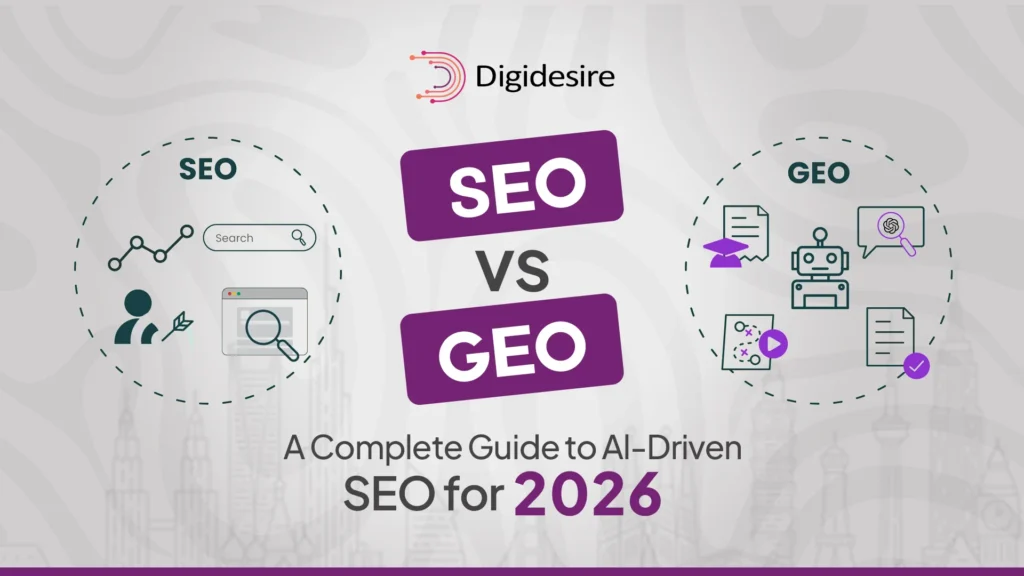
Key Takeaways SEO vs. GEO: SEO drives traffic and conversions through search engine rankings, while GEO focuses on appearing in AI-generated answers and summaries. Evolution of SEO: From keyword stuffing in the 1990s to AI-driven, intent-focused optimization in 2026. AI in SEO: Automates keyword research, predicts user behavior, and improves content and link-building strategies. GEO Essentials: Optimizes content for AI engines like Google AI Overviews (SGE) using entities, structured data, and context. Targeting Approach: SEO focuses on keywords, backlinks, and content relevance; GEO targets entities, structured data, and AI snippets. Metrics to Track: SEO—organic traffic, CTR, rankings; GEO—AI impressions, snippet appearances, branded searches. Integration Strategy: Map keywords to entities, structure content with headings/schema, optimize metadata, and use LLM strategies. Technical Best Practices: Mobile-first indexing, structured data, schema markup, and consistent local NAP for GEO. Content Strategies: AI-assisted optimization, hyper-local content for GEO, and topic clusters for SEO authority. Continuous Monitoring: Track performance with AI dashboards, adjust based on predictive insights, and monitor entity visibility. Common Pitfalls: Over-reliance on AI, ignoring user intent, duplicate content, and misalignment of SEO/GEO goals. Future Trends: Voice search, visual search, AI-driven SERP features, and hyper-personalized content. Balanced Approach: Combining SEO and GEO ensures maximum reach, brand authority, and visibility in 2026. In fact, SEO and GEO are two brilliant inventors in the digital dreamland. SEO drives clicks to your website to build authority, while GEO offers direct answers in AI overviews to the exact questions people are searching for. Imagine you have a specific problem, and your business has the perfect solution. When you turn to a search engine, you are surprisingly faced with two options. One offers you a direct answer immediately, while the other requires a click and a search through a webpage. Which one would you choose? That choice illustrates the massive shift between Search Engine Optimization (SEO) and Generative Engine Optimization (GEO) in 2026. Don’t miss a chance to rank—we have the secret AI-Driven recipe right here. In this guide, we’ve covered every essential part of GEO and SEO to help you dominate the search results. Let’s begin with the historical evolution of SEO. Do you know about 58.5% clicks were reduced by GEO? We do this to drive clicks on your website AI SEO That Works: Boost visibility for search engines & AI. Smarter Optimization: SEO for humans and AI. Proven Expertise: Grow traffic, leads & revenue. Get Started Now How SEO Has Evolved? SEO faced many phases from the infancy era to maturity. Even today, SEO is completely evolving for better website performance. Here is a breakdown for your easy understanding: The Early Days SEO Story In the late 1990s, SEO was simple. Search engines focus on keywords to appear and rank based on this criterion. Websites repeated the same keyword again and again to rank higher. It worked, but the content was unreadable and offered little value to users. The Rise of Backlinks In the early 2000s, Google introduced backlinks as a ranking factor. Links acted like votes of trust. More links meant higher rankings. This led to link spam, where sites bought or created fake links just to rank, even if their content was poor. Google Fights Low-Quality Content Google updates like Panda and Penguin changed everything. Thin content and spammy backlinks started getting penalized. SEO shifted from shortcuts to quality. Helpful, original content began to outperform keyword-stuffed pages. Mobile Became a Ranking Factor As mobile usage increased, Google moved to mobile-first indexing. Websites that were slow or not mobile-friendly lost visibility. A smooth mobile experience became essential for SEO success. User Experience Takes Center Stage Google started measuring how users interact with websites. Page speed, layout stability, and ease of use now impact rankings. Fast, clean, and user-friendly sites perform better in search results. Search Intent and AI Shape Modern SEO Today, SEO focuses on understanding search intent. Google shows results based on what users want, not just keywords. AI-powered search rewards clear, relevant, and human-written content. Trust and Expertise Matter More Than Ever Modern SEO values experience, expertise, authority, and trust. Content written by real experts ranks better. Helping users honestly is now the strongest SEO strategy. Understanding SEO in 2026 SEO remains the backbone of digital visibility. However, the integration of AI is changing how search engines rank content and how businesses optimize their websites. SEO is no longer just about keywords; it’s about relevance, user experience, and intent. What Is Search Engine Optimization (SEO) Search Engine Optimization (SEO) is a practice to make a website visible and high-performing in search engine results pages. SEO is a traditional method to rank a website. This includes on-page factors like content quality, meta tags, and internal links, as well as off-page factors like backlinks. With AI, SEO now focuses on user intent, semantic search, and predictive results. The goal is to make your website helpful and authoritative so both search engines and users find it valuable. AI Contribution in Traditional SEO Automates keyword research and trend analysis Enhances content optimization using natural language processing Predicts search intent and user behavior patterns Improves link-building strategies through AI-powered recommendations Understanding GEO in 2026 Generative Engine Optimization (GEO) is the next evolution of search optimization. It focuses on AI-driven platforms, which generate content and answers directly for users, often reducing the need for clicks. What Is Generative Engine Optimization (GEO) GEO optimizes content for AI-powered engines like Google’s AI Overviews (SGE). Instead of targeting keywords, GEO targets entities, context, and structured data. The goal is to ensure your content is included in AI-generated answers and snippets. This approach is essential as Zero-Click Searches increase. Users often get answers from AI summaries without visiting your site, so optimizing for GEO ensures your brand still gets visibility and authority. AI Contribution in GEO Identifies relevant entities and context for AI answers Optimizes content structure for AI-generated summaries Uses LLM optimization strategies for better inclusion in AI snippets Monitors AI-driven search trends and predictive user behavior How Does GEO Differ From
How E-E-A-T is Playing a Role in Answer Engine Optimization (2026)

Key Takeaways Trust is everything: Users and AI systems now prioritize reliable, credible sources over just top-ranking pages. SEO, AEO, and GEO work together: SEO ensures content is discoverable. AEO makes content answer-focused and AI-ready. GEO builds authority and long-term AI visibility. E-E-A-T is non-negotiable: Experience, Expertise, Authority, and Trustworthiness determine whether content is surfaced, summarized, or ignored. Content must be human-first: Clear, structured, experience-driven content earns trust and AI citations better than keyword-stuffed pages. Technical performance still matters: Fast-loading, mobile-friendly, and well-structured sites support trust and visibility across all engines. AI shifts traffic patterns: Visibility now includes featured answers, summaries, and Discover feeds, not just clicks or rankings. Real-world proof matters: Projects like Dubai Private Adventure show how combining SEO, AEO, and GEO drives visibility, engagement, and high-intent conversions. Ethical optimization wins long-term: Avoid clickbait, fake expertise, and shortcuts; trust lost is hard to regain. The future is trust-driven: Brands and creators who focus on credibility, clarity, and helpful content will dominate AI-powered search ecosystems. Build for humans, earn AI trust: Content grounded in real experience and honesty is the key to sustainable visibility in 2026 and beyond. Search has not stopped working, and it has not lost its purpose. What has changed is the way visibility is earned and the way information is delivered to users. In earlier years, appearing at the top of search results was often enough to attract attention. Users clicked links, scanned pages, and decided which source to trust on their own. In 2026, that behavior still exists, but it is no longer the default. Users increasingly receive answers directly through AI-powered summaries, featured responses, voice assistants, and personalized Discover feeds. In many situations, the answer appears before a list of links is even shown. This shift has not removed the importance of websites, but it has changed how websites are evaluated and used. Modern search systems no longer focus only on relevance. They focus on confidence. They ask whether a source is reliable enough to be shown as an answer, cited by an AI system, or recommended to users without additional context. This change places trust at the center of visibility. This is where E-E-A-T becomes critical. Experience, expertise, authoritativeness, and trustworthiness now determine whether content is surfaced, summarized, or ignored. Ranking still matters, but ranking alone does not guarantee visibility. In many cases, the most visible content is not the highest-ranked page but the most trusted one. This guide explains how E-E-A-T shapes Answer Engine Optimization in 2026. It also explains how SEO, AEO, and GEO work together, how Google evaluates content quality today, and how creators can build sustainable visibility by focusing on human value instead of algorithm shortcuts. Have you ever wondered why AEO and GEO are outpacing traditional SEO? Join the 24% of business owners who are already shifting their SEO strategies to focus on Generative AI search—and stay ahead of the curve! Upgrade Your SEO Strategy Today What Is Engine Optimization in 2026? Engine optimization in 2026 is no longer a narrow practice. It does not refer only to improving rankings on traditional search engines. Instead, it refers to preparing content so it can be understood, trusted, and reused across multiple systems that deliver information to users in different ways. Today, content must perform well not only in classic search results but also in AI answers, generative summaries, and discovery-based feeds. Each of these systems evaluates content differently, but all of them share one requirement: trust. If you’re looking for E-commerce SEO in 2026, Learn about it. The Evolution of Search Engines Traditional search engines were originally designed to organize the web. Their primary function was to crawl pages, index content, and rank results based on relevance signals such as keywords and links. This model worked when the web was smaller, and content production was slower. As the internet expanded, this approach became less effective. Low-quality content began to dominate results. Pages were created to satisfy algorithms rather than users. Finding accurate information required more effort from users, not less. To solve this problem, search engines evolved. They began focusing on intent rather than exact keyword matches. They introduced rich results, featured snippets, and knowledge panels. Over time, answer engines emerged to reduce user effort even further by providing direct responses instead of lists of options. Generative engines represent the next step in this evolution. These systems summarize information, compare viewpoints, and recommend sources in conversational formats. Their goal is not to show everything, but to show what is most reliable. Each stage of this evolution increases the importance of trust. When systems decide information on behalf of users, accuracy and credibility become non-negotiable. The Three Pillars of Modern Optimization Optimization Pillar Key Focus Primary Goal SEO (Search Engine Optimization) Technical structure & discoverability Make content easy to find & crawl AEO (Answer Engine Optimization) Clear answers & user intent Be chosen as a trusted answer GEO (Generative Engine Optimization) AI visibility & authority Appear in AI summaries & recommendations Modern engine optimization rests on three interconnected pillars that support one another. Search Engine Optimization: ensures that content can be discovered, crawled, indexed, and interpreted correctly. It covers technical structure, internal linking, and foundational relevance. Without SEO, content struggles to enter the ecosystem at all. Answer Engine Optimization: focuses on clarity and usefulness. It ensures content is written and structured in a way that allows systems to confidently extract and present answers. AEO is not about ranking higher but about being chosen as a reliable source. Generative Engine Optimization: focuses on visibility within AI-generated responses. It helps brands and creators become recognized entities whose content is referenced, summarized, or mentioned even when no click occurs. These three pillars do not replace one another. SEO enables access, AEO enables selection, and GEO enables long-term influence. Understanding E-E-A-T: The Core Trust Framework E-E-A-T exists because trust cannot be guessed. In a digital environment where content can be created instantly and at scale, systems need reliable ways to evaluate credibility.
Winning Google Ads Campaign Strategy For Dubai: 2026 Growth Guide
In Dubai’s fast-paced digital world, your brand needs to be more than just present, it needs to be seen instantly. With high-intent consumers and no room for slow experiences, a smart Google Ads strategy is your most powerful tool. It’s not just about buying clicks; it’s about starting real conversations with people actively searching for you. This guide moves beyond basic settings to offer a strategic blueprint designed for the UAE market. We’ll show you how to build a lead-generation engine that connects with your audience in real-time. Turn your ad spend into measurable growth and claim the market dominance your business deserves in this global hub. Stop Losing Leads to Slow Landing Pages Get a free PPC performance and speed audit to identify issues that are costing you clicks, conversions, and revenue. Audit My Campaign Now The Unique Imperative of Google Ads in the UAE Market The United Arab Emirates presents a digital marketer’s paradox: a land of immense opportunity tempered by fierce competition and a discerning, diverse audience. The effectiveness of Google Search Ads here is unparalleled due to several unique market characteristics: High Purchase Intent and Disposable Income: Searches in the UAE often signal a readiness to buy. Users are researching with the intent to transact, making a well-placed ad at the right moment exceptionally valuable. Mobile-First Dominance: With smartphone penetration exceeding 90% and a significant portion of the day spent on mobile devices, your Google Ads campaigns must be architected for the small screen from inception. A non-mobile-optimized experience is an instant conversion killer. A Multicultural Audience Mosaic: The UAE’s population is a blend of local Emiratis, long-term Arab and Western expatriates, and a vast South Asian workforce. A one-size-fits-all message fails to resonate. Successful campaigns require nuanced segmentation and multilingual targeting. Intense Sector-Specific Competition: Keywords in verticals like real estate, luxury retail, legal services, hospitality, and automotive command premium costs. In this environment, a generic campaign is a fast track to budget depletion with minimal return. Success demands a hyper-strategic, localized approach. This context makes a sophisticated, data-driven Google Ads campaign strategy for Dubai not just an option, but a fundamental requirement for sustainable business growth. The Strategic Blueprint: A 5-Pillar Framework for Success Building a high-converting campaign is a systematic process. Follow this five-pillar framework to structure your approach from the ground up. Pillar 1: Foundational Keyword Strategy & Market Intelligence Before a single ad is written, deep market intelligence is required. Your keyword strategy is the bedrock of your entire campaign. Intent-Based Keyword Segmentation: Categorize your keywords by user intent to create tightly themed ad groups. This allows for highly relevant ad copy and improves Quality Score, a critical Google metric that lowers cost-per-click (CPC). Navigational: Users searching for your brand name (e.g., “Alpha Law Firm Dubai”). Commercial Investigation: Users comparing options (e.g., “best corporate tax consultant UAE vs.”). Transactional: Users ready to buy or inquire (e.g., “book Dubai Marina yacht charter,” “hire VAT consultant in DIFC”). Leverage Localized Search Terms: Incorporate Arabic search terms (in Arabic script) and local transliterations (e.g., “Mall of the Emirates” vs. “MOE”). Use Google’s Keyword Planner with location set to “United Arab Emirates” to get accurate local search volume data. Employ a Balanced Match Type Strategy: Start with a core of exact and phrase match keywords for control and intent capture. Use broad match modifiers cautiously and only with a robust list of negative keywords to filter out irrelevant, budget-wasting searches from tourists or job seekers. Pillar 2: Hyper-Localized Audience Targeting & Bidding Precision in targeting ensures your budget is spent on reaching the most likely converters within the UAE’s diverse populace. Geographic Precision: Go beyond “Dubai.” Create separate campaigns or ad groups for key commercial hubs (DIFC, Dubai Internet City, JLT) and affluent residential areas (Emirates Hills, Palm Jumeirah, Arabian Ranches). Exclude areas irrelevant to your business. Demographic & Affinity Targeting: Layer on demographic targeting (age, household income) and affinity audiences (e.g., “Luxury Travelers,” “Business Professionals”) to refine your reach. For B2B campaigns, use in-market audiences like “Management consultants” or “Commercial real estate.” Smart Bidding for Maximized Value: Once conversion tracking is robustly implemented, migrate from manual bidding to Google’s AI-powered Smart Bidding strategies. Maximize Conversion Value is particularly powerful for e-commerce or high-value service providers, as it automatically sets bids to drive the highest total revenue from your budget. Pillar 3: Crafting Culturally Resonant Ad Copy & Extensions Your ad is your 24/7 salesperson. In the UAE’s cluttered digital space, it must command attention and communicate value instantly. Creative Element Strategic Application for the UAE Market Headline 1 (The Hook) Combine a high-intent keyword with a powerful benefit. Example: “Corporate Tax Compliance UAE Expert DIFC Advisors.” Headlines 2 & 3 (The Differentiator) Highlight unique selling propositions (USPs): “100% Compliance Guarantee,” “Same-Day Service in Dubai,” “Exclusive Ramadan Offer.” Descriptions (The Persuasion) Use social proof and urgency: “Trusted by 500+ UAE Businesses,” “Book Your Free Consultation Before Month-End.” Ad Extensions (The Experience) Mandatory. Use Sitelink Extensions for key pages (“Our Team,” “Client Reviews”), Call Extensions for immediate connection, Location Extensions to show proximity, and Structured Snippets to list services. Dual-Language Campaigns: This is non-negotiable. Run fully separate, optimized campaigns in English and Arabic. Machine translation is insufficient. Work with a native Arabic copywriter to ensure cultural nuance, formal versus dialectal appropriateness, and local search intent alignment. Seasonal Relevance: Align ad messaging with the UAE’s cultural and commercial calendar. Create dedicated ad copy and promotions for Ramadan, Eid, Dubai Shopping Festival, Dubai Summer Surprises, and National Day. Pillar 4: The Conversion Engine: Landing Page Optimization The most brilliant ad fails if the landing page experience is poor. Landing page optimization for Dubai PPC is where the conversion is ultimately won or lost. Message Match Continuity: The headline, imagery, and core offer on your landing page must be a seamless continuation of your ad. Any disconnect increases bounce rates. Mobile-First Design & Speed: The page must load in under 3 seconds on a mobile