Content Marketing vs Digital Marketing: Key Differences You Should Know
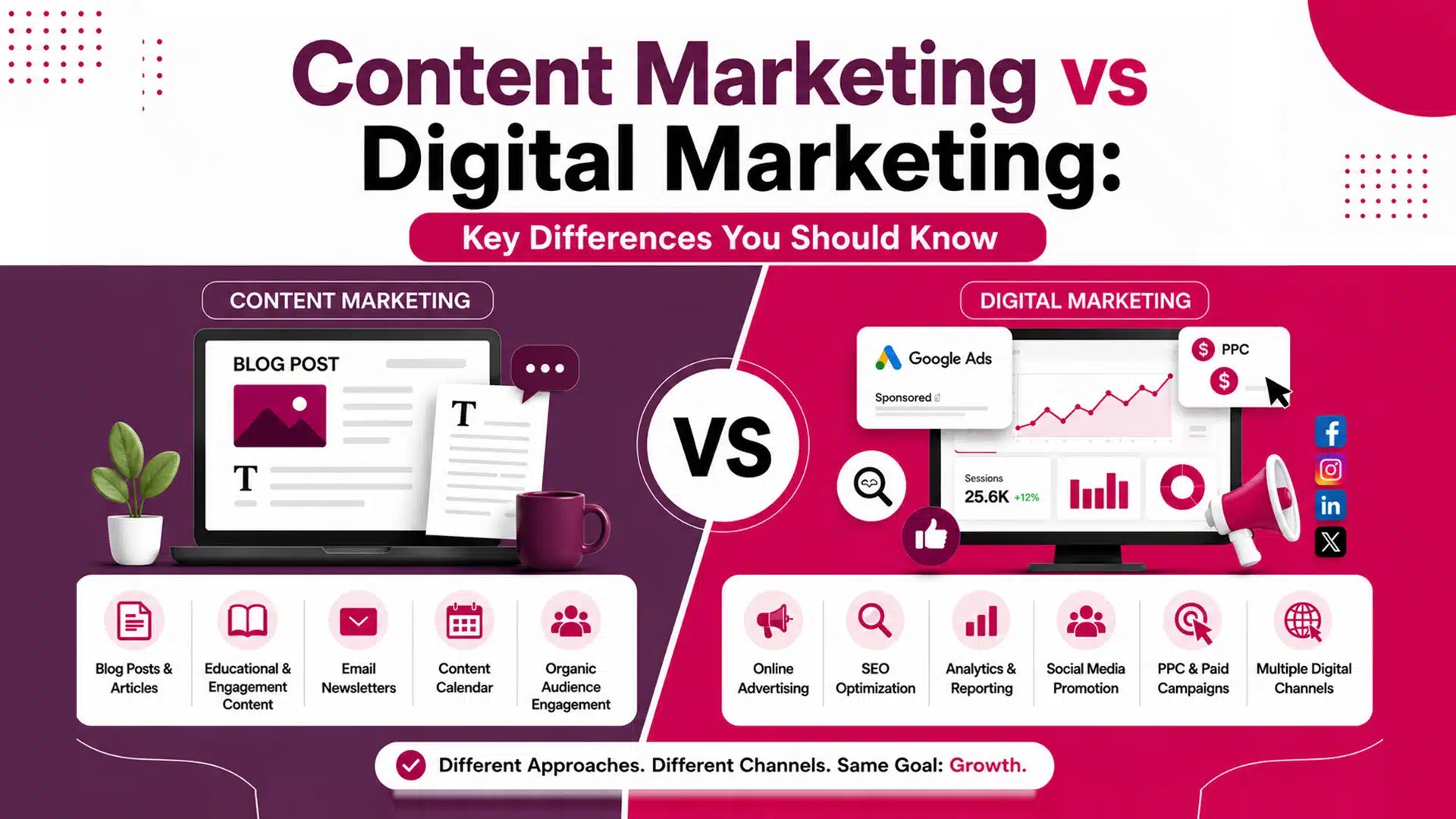
Content marketing vs digital marketing is one of those comparisons that sounds simple at first, but it can get confusing fast. You are probably here to understand the real difference between them and decide which one matters more for your business. But the real question is not only which one works faster, but which one works better in the long term.
Read on to find out the difference in simple words, how both support business growth, and where to focus your time, budget, and strategy.
Key Takeaways
- Digital marketing is the full online system that helps people find, trust, and buy from your business.
- Content marketing builds trust by answering customer questions before they are ready to buy.
- Content marketing builds authority, while digital marketing uses multiple channels to bring traffic, leads, and sales.
- The best content answers real customer questions and guides readers toward the next step.
- Start with your customer’s biggest question, then build content and campaigns around that intent.
What is digital marketing in simple terms?
Digital marketing is the process of promoting your business through online channels.
That includes search engines, websites, paid ads, social media, email, mobile apps, online marketplaces, and review platforms. The goal is to help people find you, understand your offer, take action, and become customers.
A practical example is a clinic running Google Ads for “teeth whitening near me,” sending visitors to a landing page, tracking calls, retargeting visitors on Instagram, and sending follow-up emails. That full journey is digital marketing.
Common Digital marketing types include:
- Search engine optimization
- Google Ads and PPC
- Social media marketing
- Email marketing
- Influencer marketing
- Video marketing
- Local SEO
- Landing page optimization
- Retargeting campaigns
- Analytics and reporting
Digital Marketing Advantages
- Laser-Focused Targeting: Unlike a billboard that everyone sees, digital marketing lets you show ads only to people of a certain age, location, or interest.
- Instant Results: If you run a paid ad today, you can get clicks and sales by this afternoon. It’s the fastest way to jumpstart your growth.
- Easy to Track: You can see exactly how many people clicked your link and what they did next. No more guessing if your money is being wasted.
- Level Playing Field: A small business can compete with a global brand by using smart keywords and a local strategy, even without a million-dollar budget.
- Global Reach: You can sell a product to someone in Tokyo while sitting in your pajamas in Chicago. The internet has no borders.
Which digital marketing types should you use?
The best channel depends on your goal, budget, audience, and offer. Still, most businesses need a mix rather than one channel alone.
For fast demand, paid search works well because people are already looking for a solution. For trust, SEO and content work better over time. For awareness, short-form video and social media can help people remember your brand. For repeat sales, email and retargeting keep your brand close.
Strong Digital marketing examples include:
- A salon using Google Ads for booking-ready keywords
- A B2B software company using LinkedIn Ads for demo requests
- An e-commerce brand using Meta Ads and abandoned cart emails
- A restaurant using local SEO, reviews, reels, and WhatsApp bookings
- A consultancy using SEO blogs, case studies, and email nurturing
What is content marketing, in real life?
Content marketing is the process of creating useful content that helps your audience before they buy.
It can educate, explain, compare, answer, inspire, and build trust. The content may be a blog post, video, guide, case study, email, FAQ page, social post, infographic, or product comparison.
The purpose is simple: help your audience make a better decision.
For example, a real estate agency can publish a guide on “how to choose the right apartment location before moving.” That guide may not sell directly in the first paragraph, but it builds trust with people who are already thinking about moving.
Popular content marketing types include:
- Blog posts
- Website service pages
- Case studies
- Short-form videos
- Buyer guides
- Email newsletters
- Infographics
- FAQs
- Product comparison pages
- Customer stories
Content Marketing Advantages
- Compound Interest (SEO): A great blog post works for you forever. Unlike an ad that stops working the moment you stop paying, content keeps bringing in traffic for years.
- Lower Long-Term Cost: It costs time to write, but you aren’t paying for every “click.” Over time, content marketing is often much cheaper than paid advertising.
- Educates Your Customer: Content helps people understand why they need your product before they even see a “Buy Now” button.
- Fewer Annoyances: Most people hate pop-up ads, but they love helpful articles or entertaining videos. Content marketing feels like a gift, not a sales pitch.
Explore a Smarter Digital Growth Path
Your business does not need random marketing activity. It needs a clear system where content, SEO, paid campaigns, and performance tracking work together. At Digidesire, our approach is simple: understand your audience, build trust through useful content, and turn attention into real enquiries with measurable digital marketing.
Which content marketing types work best?
The best content usually answers a real question your customer is already asking.
For service businesses, blogs, FAQs, service pages, and case studies work well. For e-commerce brands, product guides, comparison pages, reviews, and short videos often perform better. For B2B companies, reports, webinars, case studies, and LinkedIn content can support longer sales cycles.
Useful content marketing examples include:
- A pricing guide that explains what affects cost
- A case study showing before-and-after campaign results
- A comparison page between two service options
- A short video answering one common customer question
- A blog that explains a problem before offering a solution
A strong content piece should do three things: answer the question, prove the answer, and guide the next step.
That next step could be reading a related guide, visiting a service page, booking a consultation, downloading a checklist, or contacting your team.
How Are the Two Different?
Here is the cleanest answer to What are the key differences between digital marketing and content marketing?
Digital marketing is the full online growth system. Content marketing is the trust-building content layer inside that system.
Point | Content Marketing | Digital Marketing |
Main role | Builds trust and authority | Drives reach, leads, and sales |
Scope | Narrower | Broader |
Main assets | Blogs, videos, guides, FAQs | Ads, SEO, email, social, websites |
Speed | Often long-term | Can be fast and long-term |
Cost | Creation and distribution | Ads, tools, content, tracking |
Best use | Education and trust | Promotion and conversion |
Example | A helpful comparison guide | SEO + ads + landing page + email |
The difference matters because many businesses treat content as “just posting.” That is where they lose money. Good content has a purpose. Good digital marketing has a system.
How do both work together for online growth?
This is where the real value appears.
Content marketing creates the material people need. Digital marketing distributes that material through the right channels.
A simple customer journey may look like this:
- Someone searches for a question on Google.
- Your blog answers it clearly.
- They visit your service page.
- A retargeting ad reminds them later.
- They read a case study.
- They submit a form or message you on WhatsApp.
- Your sales team follows up with context.
That is not just content. That is not just ads. That is a connected marketing system.
Need Expert Clarity on Your Digital Strategy?
If you are unsure whether your business needs better content, stronger SEO, paid campaigns, or a full digital audit, our team can help you find the right direction. Get expert guidance based on your goals, current performance, and growth opportunities.
What should your next marketing move be?

Start with the goal you want to reach first.
If you need faster leads, digital marketing usually gives clearer short-term direction. Paid ads, SEO service pages, landing pages, retargeting, and email follow-ups can help you reach people who are already searching, comparing, or ready to buy. This is useful when your business needs enquiries now, wants to test a new offer, or has a clear budget for customer acquisition.
Budget also matters. Digital marketing can bring quicker data, but it often needs ongoing spend for ads, tools, tracking, and campaign management. The benefit is that you can measure cost per lead, conversion rate, return on ad spend, and which channels are producing real sales opportunities.
Content marketing works better when your audience needs more education before they trust you. It may take longer to show results, but the return can grow over time because one strong guide, case study, comparison page, or FAQ can keep supporting SEO, sales calls, email campaigns, and paid ads after it is published.
For ROI, the choice depends on your goal. If you need leads this month, digital marketing may be the better starting point. If you want to reduce future ad dependence, improve lead quality, and build long-term search visibility, content marketing should be part of the plan.
For most businesses, the best approach is not to choose one side. Use content marketing inside your digital marketing strategy. This gives your campaigns better pages, stronger messages, and more reasons for people to trust your business.
To get optimum results, working with the best digital marketing agency can help you connect content, campaigns, tracking, and sales goals in one clear plan.
Grow Faster with Digital Marketing Services That Convert
Ready to turn your online presence into leads, sales, and long-term brand growth? Explore our digital marketing services and see how SEO, content marketing, paid ads, social media, and conversion-focused campaigns can work together for your business.
FAQs
It helps to understand digital marketing basics first. Content performs better when you understand SEO, audience intent, distribution, analytics, and how people move from reading content to taking action.
For small businesses, digital marketing is usually better for quick visibility and leads, while content marketing is better for long-term trust and organic growth.The best choice is to use both together: start with simple content that answers customer questions, then promote it through SEO, local search, social media, email, or paid ads.
Yes, it can work through SEO, email, social sharing, and referrals. Ads can speed up distribution, but they are not always required.
Hire a digital marketing expert when you need strategy, audits, or specialist support. Hire an agency when you need a full team for SEO, paid ads, content, design, tracking, and reporting.
A good partner should show real examples, explain strategy clearly, track leads, understand your customer journey, connect content with campaigns, and report what changed.
Measure results by business impact, not traffic alone.
Track organic clicks, keyword visibility, conversion rate, cost per lead, lead quality, calls, WhatsApp enquiries, email sign-ups, assisted conversions, ROAS, and sales pipeline value.
For content, also track scroll depth, time on page, internal clicks, returning visitors, and form submissions.
The best content marketing platforms for small businesses are WordPress for blogging, Canva for visuals, Semrush for SEO content planning, Mailchimp for email content, and HubSpot for CRM-based campaigns.
Together, these tools help small teams plan topics, create content, publish consistently, promote through email, and measure results without needing a large marketing department. Canva supports fast branded content creation, Semrush helps with SEO-focused content workflows, Mailchimp supports email and automation, and HubSpot connects marketing with customer data.
Content marketing answers doubts before a sales conversation starts. It helps people compare options, understand pricing factors, learn what to expect, and feel more confident before they send an enquiry or book a service.
Yes, but it should not depend only on social media reach. Strong content can support SEO, email, sales follow-ups, paid ads, landing pages, and retargeting. The value is bigger when content is used across several channels.
Table of Contents
Categories
Featured Posts
-

How Local Google Ads Management Drives High-Quality Leads
May 15, 2026 -
Content Marketing vs Digital Marketing: Key Differences You Should Know
May 13, 2026 -
What Is llms.txt—Does Your Website Need One in 2026?
May 12, 2026 -
The Zero-Click Era: How to Get Traffic When Nobody Is Clicking
May 6, 2026 -
How Generative Engine Optimization Improves AI Search Rankings
May 5, 2026