Why LLMs Trust Strangers Over Your Brand—And What To Do About It
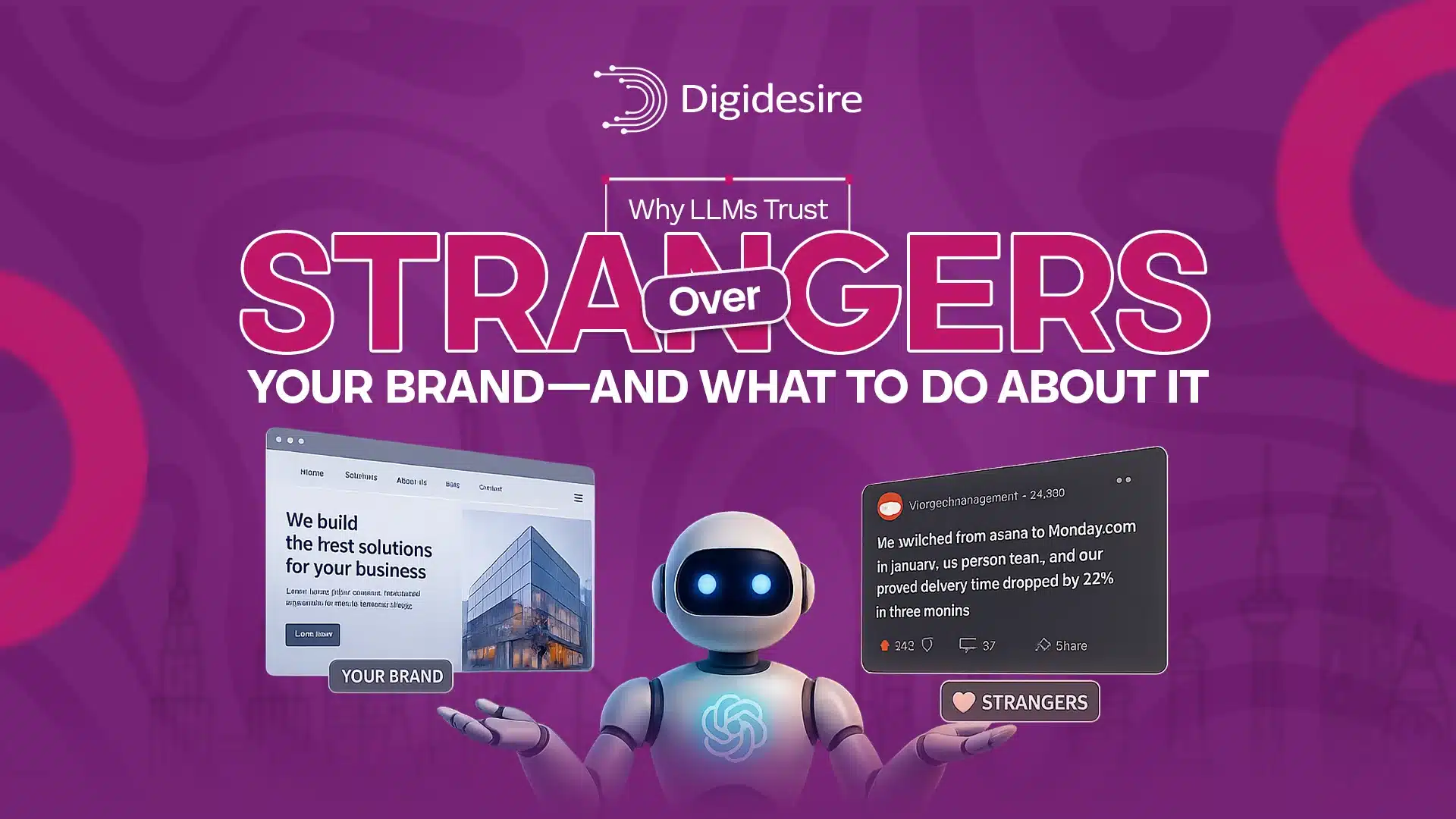
You’ve done everything right. Your website ranks on page one. Your content is polished, on-brand, and technically optimized. But when someone types your category into ChatGPT or Perplexity, the AI ignores your site and cites a Reddit thread instead.
This isn’t a glitch. It’s how large language models are built to work — and if you haven’t adjusted your strategy for it yet, you’re losing visibility to brands that have.
Key Takeaways
- AI search no longer follows Google rankings — it selects sources based on experience, specificity, and extractable facts, not domain authority.
- User-generated content (Reddit, forums, reviews) often outranks brand websites because it contains real, detailed, experience-backed information.
- There is a growing gap called “The Great Decoupling,” where top Google pages may not appear in AI citations at all.
- LLMs prioritize entity-rich content (names, numbers, outcomes, timelines), making vague brand messaging less visible in AI answers.
- Earned media and community mentions now drive a larger share of AI citations than owned brand content, shaping how AI “describes” your brand.
- Winning in AI search requires a GEO strategy: structured content, Reddit participation, YouTube transcripts, and strong reputation signals across platforms.
Why Does AI Trust Reddit More Than Your Site?
The answer comes down to something called entity density and the “Experience” signal in Google’s own E-E-A-T framework.
AI models don’t rank pages the way Google does. They select sources that contain specific, verifiable, experience-backed information — facts a model can extract cleanly and present to a user with confidence. And user-generated content (UGC) naturally delivers exactly that.
Think about the difference between these two sentences:

Brand copy: “Our platform is a leading solution that helps teams improve collaboration.”
Reddit comment: “We switched from Asana to Monday.com in January, 15-person team, and our project delivery time dropped by 22% in three months.”
One is vague. One is packed with specific entities — a brand name, a competing brand, a timeline, a team size, and a measurable outcome. Research shows that content cited by LLMs has an entity density of around 20.6%, compared to the 5–8% found in typical brand writing. That gap is why a forum thread beats your homepage in an AI-generated answer.
The deeper reason is the first “E” in E-E-A-T: Experience. A corporate blog post titled “5 Tips for Better Project Management” carries no experience signal. A Reddit post where a real project manager describes rescuing a failing sprint using a specific tool? That’s lived experience. LLMs can tell the difference because they were trained on the difference.
Ready to Be the Brand AI Recommends?
We help brands improve content, reputation signals, and GEO strategy to stay visible in AI search and communities.
What Is “The Great Decoupling” and Why Should You Care?
Kevin Indig of Growth Memo coined this phrase, and it describes something every SEO agency and globally should be tracking right now: organic search rankings and AI citations have fully split apart.
A page can rank #1 on Google and receive zero citations from ChatGPT. Meanwhile, a Reddit thread that never appears on page one might get cited by Perplexity, referenced by Claude, and pulled into Google AI Overviews. The two systems are no longer measuring the same thing.
Traditional SEO metrics like domain authority and backlinks now predict only 4–7% of AI citation behavior. That’s not a declining factor — it’s near-irrelevance when it comes to generative search answers. Yet most brands are still optimizing exclusively for the old system.
How Much of What AI Says About You Comes From Sources You Don’t Own?
More than most brands realize.
An analysis of over 23,000 AI citations found that when users ask LLMs brand-specific questions, earned media sources account for nearly 48% of all citations — things like review sites, forums, editorial coverage, and community platforms. Your own brand content accounts for just 23%.
It’s even more striking when you break it down by query type. When someone asks “What do customers say about [brand]?”, LLMs cite earned media sources 82% of the time. They’re not going to your website. They’re going to TrustPilot, Reddit, and social platforms to build their answer.
This means AI is already writing the first draft of your brand’s reputation — and it’s doing it largely from sources you don’t control.
Is Reddit Really More Powerful Than Your Website in AI Search?
Right now, yes — for most query types.
An analysis of over 5.5 million LLM responses across ChatGPT, Perplexity, Gemini, and Google AI Mode found that community and user-generated platforms drive nearly 48% of all AI search citations. Reddit alone appears in approximately 22% of all AI answers. It’s the #1 most-cited domain in Perplexity and Google AI Mode, and #2 in ChatGPT — just behind Wikipedia.
YouTube isn’t far behind. Video transcripts are dense with specific, actionable, entity-rich information. A 20-minute tutorial on any software product contains more citable facts than most blog posts written on the same topic. That’s why YouTube is consistently in the top three cited sources across multiple AI models.
A real example: When LLMs are asked, “What do customers say about Hoka?” — they consistently cite TrustPilot, Reddit, and community platforms, not Hoka’s own website. The AI isn’t being disloyal. It’s doing exactly what it’s designed to do: surface the sources that feel most like real people talking about real experiences.
Can Negative UGC Hurt Your AI Visibility?
This is the part most brands don’t want to hear.
Yes — and this is where SEO agencies and beyond need to start thinking about GEO (Generative Engine Optimization) and reputation management as the same discipline, not separate ones.
Negative threads can become part of how AI understands your brand. According to recent research, nearly 51% of shoppers who use AI in their buying journey abandon a purchase after AI flags a concern drawn from UGC. The AI isn’t reading your “About Us” page when it builds that concern. It’s reading reviews, forum complaints, and community discussions.
You cannot suppress those posts. You can’t outrank them with paid ads. What you can do is build a strong enough body of authentic, positive UGC that the overall picture the AI assembles is accurate and balanced.
Monitoring community conversations is now a GEO function, not just a PR one.
What Should You Actually Do About It?

01 — BUILD REDDIT PRESENCEHave real experts participate in relevant communities. 95% value, 5% brand mentions. No shortcuts — Reddit rewards people, not logos. 02 — WRITE FOR EXTRACTIONReplace vague language with specific names, numbers, and outcomes. Every sentence should contain a fact that an LLM can lift cleanly. 03 — INVEST IN YOUTUBEVideo transcripts are entity-dense goldmines. A 20-min tutorial contains more citable facts than most blog posts on the same topic. 04 — CHECK AI CRAWLER ACCESS68% of enterprise sites block at least one major AI crawler. If GPTBot can’t read your content, it doesn’t exist to ChatGPT. |
This is where strategy matters more than panic. UGC doesn’t replace owned content — it validates it. If your brand’s own content is weak or outdated, no amount of Reddit presence will save your AI visibility. But if you combine strong owned content with genuine community engagement, the two reinforce each other as citation signals.
Here’s what actually moves the needle:
How Do You Build Genuine Reddit Authority?
The brands that win here — companies like Datadog and Zapier — have subject matter experts who participate in relevant subreddits as themselves, not as brand representatives. They answer real questions, share context, and occasionally mention their products when it’s directly relevant. This credibility, built over months, compounds into AI citations over time.
The 95/5 rule applies: 95% of your contributions should be genuinely useful community participation. 5% or less should involve brand mentions. Reddit’s moderators and its community are extremely effective at detecting promotional posting, and getting flagged as spam permanently damages your AI citation potential in those communities.
How Do You Make Your Owned Content More Citable?
Stop writing for the search engine. Start writing for extraction. Every paragraph should contain a fact that an LLM can pull out cleanly and present to a user.
- Replace “industry-leading solution” with actual product names, version numbers, and use cases
- Include specific numbers, timelines, and outcomes — not just general claims
- Lead every section with the direct answer to the implied question
- Use clear headings so AI can map your content structure
Turn AI Mentions Into Business Growth
Strengthen your presence across search, reviews, and AI platforms to stay visible in the next era of search.
Research confirms that comparison pages with three or more data tables earn 25.7% more citations than pages without them. Shortlist-style pages with sentences averaging ten words or fewer earn 18.8% more citations. Structure is not just cosmetic — it is a citation signal.
Are You Blocking AI Crawlers Without Knowing It?
An audit of 50 enterprise SaaS websites found that 68% were inadvertently blocking at least one major AI crawler through their robots.txt settings. If GPTBot or PerplexityBot can’t read your content, that content simply doesn’t exist in those platforms’ answer ecosystems. Check your crawl permissions before doing anything else.
The New Definition of Brand Authority
For two decades, authority online meant backlinks and rankings. In the generative search era, it means something different: being the source that AI systems reach for when they need to construct a confident, specific, trustworthy answer.
That source looks less like a polished brand website and more like an authentic community conversation. It sounds less like marketing and more like a real person who used the product, had a real outcome, and described exactly what happened.
Any experienced SEO Agency Dubai working in 2026 is no longer just optimizing pages for Google — they’re building the kind of digital footprint that makes AI systems confident enough to name you. That means owned content that answers questions clearly, community presence built through genuine participation, third-party coverage across trusted publications, and a review ecosystem that reflects real customer experience.
The brands winning AI citations aren’t the loudest ones. They’re the most specific, the most consistent, and the most trusted — across every surface where people and AI look for answers.
Conclusion
The shift to AI-driven search isn’t a minor evolution — it’s a complete rewrite of how visibility and trust are earned online. Large language models are no longer rewarding the most polished brand message; they’re selecting the most specific, experience-backed, and verifiable information available across the web.
That means your brand is no longer defined only by what you publish, but by what others say about you — in communities, reviews, and conversations you don’t fully control.
Winning in this new landscape requires a mindset shift. It’s not about ranking higher; it’s about being chosen. That happens when your content is clear, structured, and rich with real data, and when your presence extends beyond your website into places where genuine experiences are shared.
The brands that succeed won’t be the loudest. They’ll be the most credible, the most consistent, and the easiest for AI to trust.
FAQs
UGC stands for User-Generated Content — reviews, forum posts, Reddit threads, YouTube videos, and any other content created by real users rather than brands. It matters for AI search because LLMs are built to prioritize sources that reflect genuine human experience. Community platforms drive nearly 48% of all citations in AI-generated answers, making UGC one of the most influential factors in whether your brand appears in responses from ChatGPT, Perplexity, or Google AI Overviews.
GEO is the practice of optimizing your content and digital presence so that AI-powered platforms—like ChatGPT, Google AI Overviews, Perplexity, and Claude — cite, recommend, or mention your brand when generating responses. Unlike traditional SEO, which focuses on ranking pages for clicks, GEO focuses on being selected as a trusted source in synthesized AI answers. It involves structured content, community presence, entity-rich writing, and third-party validation signals.
E-E-A-T stands for Experience, Expertise, Authoritativeness, and Trustworthiness — a framework Google uses to evaluate content quality. The first "E," Experience, is the signal most relevant to AI citations. LLMs favor content that demonstrates first-hand experience because it's harder to fake and provides the specific, verifiable details they need to construct confident answers. This is why a Reddit post from someone who actually used a product outperforms a brand blog post on the same topic — and why building genuine community presence is now a core part of any modern visibility strategy.
A forward-thinking SEO expert in 2026 is no longer optimizing only for Google rankings. They're building what's often called an "AI visibility stack" — combining technically clean, entity-rich owned content with genuine community presence on Reddit and LinkedIn, consistent coverage in trusted industry publications, and an active review ecosystem on platforms like G2 and Trustpilot. They're also tracking AI citation metrics alongside traditional rankings, because the two no longer move together. The goal has shifted from "ranking for keywords" to "being cited when AI answers the questions your customers are asking."
Table of Contents
Categories
Featured Posts
-

How Local Google Ads Management Drives High-Quality Leads
May 15, 2026 -
Content Marketing vs Digital Marketing: Key Differences You Should Know
May 13, 2026 -
What Is llms.txt—Does Your Website Need One in 2026?
May 12, 2026 -
The Zero-Click Era: How to Get Traffic When Nobody Is Clicking
May 6, 2026 -
How Generative Engine Optimization Improves AI Search Rankings
May 5, 2026