Why The Right Keyword Research Is Crucial for UAE Businesses
Key Takeaways
- Focus on intent-driven keywords rather than volume
- Prioritize geo-targeted and long-tail phrases
- Structure content using clusters and pillar pages
- Avoid keyword stuffing; focus on semantic relevance
- Track performance via tools like keyword planner and competitor analysis
If your website attracts traffic but fails to convert, the problem is often not design—it’s your keyword strategy in SEO. Yes! Keywords today are not just mere components of seo ranking for your website. They are radical tools to help with leads and conversions. Traffic without intent results in wasted ad spend, missed opportunities, and low ROI. Choosing the right keywords connects search intent to buyer behavior, aligns content with local demand, and drives measurable results.
How Keywords Directly Impact Your Business?
More than a chain of words, Keywords are the bridge between potential customers and your business. When used strategically, they determine not only who finds your website but also whether visitors convert into leads or sales. According to BrightEdge Research (2023), organic search drives 53% of website traffic across industries. Yet, many businesses miss out because they target keywords without intent analysis.
High-volume terms might get traffic, but if the traffic doesn’t align with commercial intent, conversions remain low. On the other hand, targeting high-intent keywords—terms users search for when they’re ready to buy—connects directly to revenue. For example, a user searching for “emergency plumbing services Abu Dhabi” is more likely to convert than someone searching for “diy plumbing guide.”
Peter Drucker famously said, “What gets measured gets managed.” In SEO, measuring intent and commercial relevance is as important as tracking clicks. Without this focus, your content risks being visible but ineffective
1. The Keyword Research That Actually Matters
Your keyword hunt is no longer just about keyword density, traffic, or search volume. In 2026, successful SEO hinges on understanding intent—especially AI-driven intent. Modern search engines, powered by advanced NLP and generative AI, evaluate not only the words on your page but the context, relevance, and semantic alignment with user queries.
For instance, a website targeting “heat pump repair” without considering whether users are seeking informational guides, comparison options, or immediate services will attract clicks but few conversions. Searching for the right keywords now involves mapping queries to buyer journey stages, transactional intent, and AI interpretations of language, ensuring your content satisfies both human readers and AI systems generating search summaries.
A study by Ahrefs (2020) revealed that 90.63% of web pages receive no organic traffic from Google, primarily due to targeting the wrong keywords or failing to align with user intent. Incorporating AI-driven intent signals—such as “emergency” vs. “DIY” modifiers or geographic qualifiers—ensures your pages are not just discoverable but relevant, actionable, and highly convertible.
Why Search Intent Comes First
Search engines prioritize relevance over raw keywords. Sundar Pichai, CEO of Google, stated in 2018 that Google’s mission is to “organize the world’s information and make it universally accessible and useful.” For content to be useful, it must satisfy both the human and AI understanding of intent.
Queries generally fall into four intent types:
- Informational: Users seek knowledge, e.g., “how does a heat pump work?”
- Commercial investigation: Users compare options, e.g., “best heat pump brands Stockholm.”
- Transactional: Users are ready to buy, e.g., “emergency heat pump repair near me.”
- Navigational: Users seek a specific website, e.g., “Noor Al Raffa Dubai tailor website.”
Classifying queries helps you structure content around the buyer journey, select AI-friendly long-tail keywords, and improve engagement and conversion. Intent-driven research ensures your content answers the right questions at the right stage, so AI systems and searchers alike understand and value your page.
Our Data-Driven Approach to Sustainable SEO
Discover how we build long-term visibility using ethical optimization, intent mapping, and measurable growth strategies aligned with your business goals.
2. Keyword Strings: What They Are and Why They Matter
A keyword string is a combination of multiple words or phrases that conveys specific search intent more clearly than a single keyword. For example:
- Single keyword: “heat pump.”
- Keyword string: “emergency heat pump repair Stockholm.”
While individual keywords highlight general topics, keyword strings provide context and precision, which is crucial in modern SEO. Search engines, especially AI-driven systems, evaluate the relationship between words, user intent, and context rather than just counting keyword occurrences. A well-crafted keyword string tells Google exactly what problem your content solves, increasing the likelihood of ranking for both organic searches and featured snippets.
Why Keyword Strings Matter
- Aligns Content with Search Intent: Users often include modifiers such as “best,” “near me,” or location-specific terms in their queries. Targeting strings like “best food caterers for weddings in Sharjah” ensures your page matches real user intent.
- Improves Relevance and Ranking: Search engines use semantic analysis to match pages with queries. Pages optimized with intent-driven keyword strings are more likely to rank higher than those optimized only for single, generic keywords.
- Increases Conversion Potential: Keyword strings often capture users in later stages of the buyer journey, such as transactional or commercial-intent queries. For example, “emergency AC repair miami” targets people ready to hire a service immediately.
Can Keyword Strings Be Used as Keywords?
Yes. Keyword strings function as long-tail keywords. They can be integrated naturally into:
- Page titles and meta descriptions
- H1/H2 headings
- Introductory paragraphs
- Product or service descriptions
- Anchor text for internal links
However, the key is contextual placement—keyword strings should read naturally and provide value to the reader, not just appear for SEO purposes. Overloading content with multiple strings can hurt readability and trigger AI/Google’s spam detection.
Where to Place Keyword Strings for Maximum Impact
- Primary headings (H1/H2): Signal the main topic of the page to search engines.
- Introductory paragraphs: Ensures search engines understand intent early.
- Meta tags and descriptions: Boosts click-through rates by showing relevance in SERPs.
- Alt text for images: Provides semantic signals for visual content indexing.
- Internal linking anchor text: Helps cluster content and distribute authority across related pages.
By strategically using keyword strings, your content satisfies both human readers and AI-driven search algorithms, increasing visibility, relevance, and conversions.
3. What Is the Best Keyword Strategy?
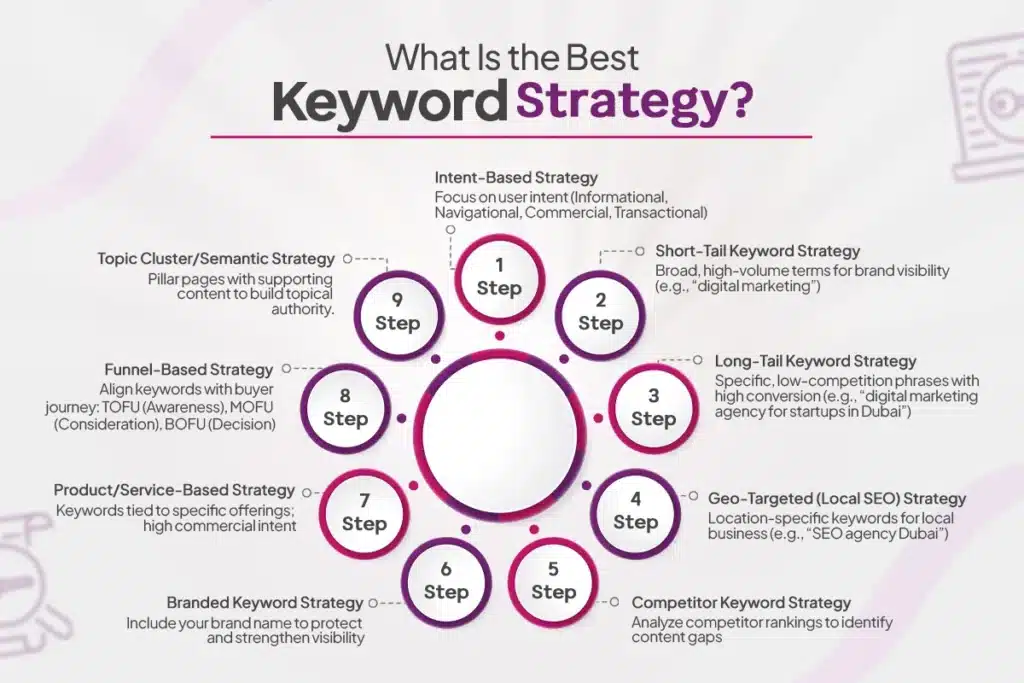
The best keyword strategy in SEO balances search volume, competition, and commercial intent while structuring content to maximize relevance. It’s not about chasing traffic—it’s about connecting with the right audience at the right time.
Types of Keyword Strategies
- Intent-Based Strategy – Focus on user intent (Informational, Navigational, Commercial, Transactional).
- Short-Tail Keyword Strategy – Broad, high-volume terms for brand visibility (e.g., “digital marketing”).
- Long-Tail Keyword Strategy – Specific, low-competition phrases with high conversion (e.g., “digital marketing agency for startups in Dubai”).
- Geo-Targeted (Local SEO) Strategy – Location-specific keywords for local business (e.g., “SEO agency Dubai”).
- Competitor Keyword Strategy – Analyze competitor rankings to identify content gaps.
- Branded Keyword Strategy – Include your brand name to protect and strengthen visibility.
- Product/Service-Based Strategy – Keywords tied to specific offerings; high commercial intent.
- Funnel-Based Strategy – Align keywords with buyer journey: TOFU (Awareness), MOFU (Consideration), BOFU (Decision).
- Topic Cluster/Semantic Strategy – Pillar pages with supporting content to build topical authority.
How to Map Keywords to Funnel Stages
- Top-of-Funnel (TOFU): Informational queries like “how to choose a heat pump” attract awareness-stage users.
- Middle-of-Funnel (MOFU): Commercial investigation queries like “best heat pump installation services UAE” attract comparison customers.
- Bottom-of-Funnel (BOFU): Transactional queries like “Criminal defense lawyer near me free consultation” capture users ready to act.
Mapping keywords to funnel stages ensures content addresses user intent effectively, which is why our clients consistently see higher engagement metrics and conversion rates.
4. How to Pick Keywords for a Website?
Keyword selection involves evaluating relevance, search volume, competition, and commercial value. Neglecting any of these factors can waste resources and lower ROI.
Short-Tail vs Long-Tail Keywords
- Short-tail keywords: Broad, competitive, high-volume terms like “heat pump repair.”
- Long-tail keywords: Specific, low-competition phrases like “emergency heat pump repair Södermalm.”
According to HubSpot Research (2023), long-tail keywords convert 36% better because they reflect precise intent. For example, when we worked with Noor Al Raffa’s luxury tailoring business, we targeted “Best Bespoke Tailor Dubai” rather than generic fashion keywords, resulting in a 44% increase in private bookings.
Filter Criteria for Keyword Selection
- Relevance to your products or services
- Commercial intent to attract buyers
- Moderate difficulty to allow an achievable ranking
- Geo-specific modifiers for local search impact
By using these filters, businesses can focus on keywords that drive revenue rather than vanity traffic.
5. How Does Local SEO Strengthen Visibility?
Geo-targeted SEO is crucial for businesses operating in a specific region. For example, near me searches in Dubai have grown exponentially over recent years, indicating users seek immediate, local solutions.
Optimizing for local intent means incorporating location modifiers into keywords, landing pages, and content. A Dubai-based tailoring business can target both English and Arabic keywords to capture bilingual searches effectively, while hvac service providers in the UAE can create suburb-level pages to attract emergency repair clients.
Local SEO also requires leveraging:
- Google My Business Profile optimization
- Local directories and listings
- Multilingual content to match the UAE’s bilingual audience
- Seasonal adjustments, e.g., Islamic holidays, SEO trends
A strategic local approach increases visibility, boosts trust, and improves conversions from users ready to act immediately.
6. Which Tools Improve Keyword Accuracy?

Reliable tools remove guesswork from keyword strategy. The combination of search volume, CPC, and competition analysis ensures you target the right terms.
- Google Keyword Planner: Provides forecast data, search volume, and CPC insights
- Ahrefs & SEMrush: Analyze competitor keywords, gaps, and opportunity terms
- SERP Analysis & PAA Mining: Reveals autocomplete trends, featured snippets, and related searches
For example, using keyword planner, we identified high-intent local phrases for Stockholm Värmepump and Service Värmepump Stockholm, which allowed us to prioritize pages targeting emergency repair searches. This strategic prioritization increased conversion rates by over 38% while reducing paid ad dependency.
7. How to Avoid Keyword Stuffing?
Keyword stuffing harms both user experience and search engine trust. Google’s Helpful Content Update (2022) penalizes sites that prioritize keyword repetition over user value.
How to Identify Keyword Stuffing
- Repetition of the same phrase in unnatural ways
- Awkward phrasing that reduces readability
- Overuse in headings and meta content
Modern SEO focuses on semantic relevance, where context and intent outweigh exact matches. Brian Dean of Backlinko emphasizes: “Modern SEO is about satisfying search intent better than anyone else—not repeating keywords.”
Keyword Density Guidelines
There is no fixed percentage. The priority is natural language and context. A well-structured page targeting “urgent heat pump repair Stockholm” should naturally include the phrase, variations, and related terms without forcing repetition.
Get a Personalized Keyword Audit
Let our specialists analyze your current keyword positioning, competitor gaps, and growth opportunities with a strategic roadmap tailored to your market.
8. How to Structure Content for AI Search?
AI-powered search systems prefer modular content that directly answers questions. Structuring content for AI means each section should:
- Address a specific question
- Use declarative sentences
- Include short bullet summaries
- Keep answers concise (40–60 words for snippets)
Structured content not only improves human readability but also increases chances of appearing in Featured Snippets, PAA results, and AI-overview extractions. It has been observed that structured content improves snippet eligibility by up to 40%.
What We Have Learned Throughout Our Tenure
Across industries, we observed three recurring challenges:
- Businesses targeted high-volume keywords instead of high-intent keywords
- Content was not structured around user journey stages
- Local modifiers were underutilized
Our solution, applied consistently, included:
- Intent-first keyword mapping
- Geo-targeted landing pages
- Cluster-based content architecture
- Data validation via keyword planner and competitor analysis
This approach consistently strengthened both rankings and conversions because it aligns content with user intent and semantic relevance.
Should You Hire an SEO Agency in Dubai?
The answer is simply yes. If you want to scale up your SEO strategy, it often requires more than DIY efforts. If you frequently face issues like stagnant rankings, low organic conversions, or challenges structuring content into effective clusters, expert intervention becomes essential. Professional guidance ensures precise technical audits, data-driven keyword mapping, and advanced funnel-based content strategies that maximize ROI.
Signs You Need Experts
Common indicators that it’s time to bring in an SEO Agency include:
- Persistent low visibility for high-intent keywords despite ongoing optimization
- Difficulty aligning content with user intent and buyer journey stages
- Challenges in implementing geo-targeted strategies and multilingual SEO
- Inefficient internal tracking of organic traffic, conversions, and keyword performance
If these issues recur, even small improvements require significant technical knowledge. Experts can streamline processes and apply best practices to achieve measurable results faster.
ROI of Professional Strategy
Investing in a professional SEO strategy yields measurable returns:
- Higher conversion rates by targeting intent-driven, long-tail, and geo-modified keywords
- Reduced wasted ad spend due to more qualified organic traffic
- Faster improvements in SERP rankings through structured topic clusters
- Scalable frameworks for long-term growth rather than short-term gains
For businesses aiming to dominate local search results, an SEO Agency Dubai ensures that every keyword, landing page, and content cluster is aligned with business goals and optimized for maximum impact
Ready to Dominate Local Search Results?
Partner with our expert team to implement advanced keyword research, multilingual optimization, and high-converting hyperlocal targeting frameworks designed for measurable ROI.
FAQs
The most reliable tools include Google Keyword Planner, Ahrefs, SEMrush, Ubersuggest, and Google Search Console.
- Google Keyword Planner is ideal for volume forecasting.
- Ahrefs and SEMrush provide competitor keyword gap analysis and keyword difficulty scores.
- Search Console reveals real queries already driving impressions.
A strong strategy combines at least two data sources for validation.
For new domains, focus on long-tail keywords with:
- Moderate search volume
- Low keyword difficulty (KD under 30 in most tools)
- Clear commercial or transactional intent
Use competitor gap analysis and filter keywords by low authority domains ranking on page one — this signals achievable opportunities.
Start with geo-modified keywords such as:
- “Digital marketing agency Dubai”
- “SEO services Abu Dhabi”
Then:
- Build location-based landing pages
- Optimize Google Business Profile
- Include Arabic and English keyword variations
- Target “near me” and district-level searches
Local intent + service modifiers drive conversions in the UAE market.
The most effective tools combine volume data, intent signals, and competitor insights:
- Ahrefs – Best for backlink and keyword gap analysis
- SEMrush – Strong for competitive positioning
- Google Keyword Planner – Reliable PPC-based volume estimates
- AnswerThePublic – Great for question-based intent
- Google Trends – Identifies seasonal demand shifts
No single tool is enough — cross-validation improves accuracy.
Keyword strategy services are typically offered by:
- Full-service SEO agencies
- Specialized SEO consultancies
- Freelance SEO strategists
- Digital marketing firms with local SEO expertise
In competitive markets like Dubai, agencies that combine technical SEO + content clustering + intent mapping provide the strongest ROI.
Effective keyword integration requires:
- Placement in H1, H2, meta title, and first 100 words
- Natural inclusion within body content
- Internal linking with contextual anchor text
- Avoiding keyword stuffing
- Structuring content in topic clusters
Search engines prioritize semantic relevance, not repetition.
7. Where to Find Keyword Strategy Consultants Near Me
You can find consultants via:
- Local SEO agencies
- LinkedIn search
- Clutch.co agency listings
- Google search (geo-modified queries like “SEO consultant Dubai”)
Look for consultants who provide case studies, technical audits, and data-backed projections — not just keyword lists.
Instead of targeting “tailor Dubai,” a stronger long-tail strategy would use:
- “Best bespoke tailor in Dubai Marina”
- “Wedding suit tailoring Dubai price”
This narrows competition, improves ranking speed, and captures users with high buying intent — leading to better conversion rates.
Small businesses should look for packages that include:
- finding keywords + competitor analysis
- On-page mapping
- Local SEO keyword planning
- 3–6 month performance roadmap
Affordable packages typically focus on a niche or geographic segment rather than broad national targeting.
In the UAE market:
- Freelance consultants: AED 1,500 – AED 5,000 per project
- SEO agencies: AED 5,000 – AED 20,000+ depending on scope
- Ongoing monthly retainers: AED 3,000 – AED 15,000
Pricing depends on competitiveness, industry, and whether technical audits, clustering, and implementation are included.
Table of Contents
Categories
Featured Posts
-

How Local Google Ads Management Drives High-Quality Leads
May 15, 2026 -
Content Marketing vs Digital Marketing: Key Differences You Should Know
May 13, 2026 -
What Is llms.txt—Does Your Website Need One in 2026?
May 12, 2026 -
The Zero-Click Era: How to Get Traffic When Nobody Is Clicking
May 6, 2026 -
How Generative Engine Optimization Improves AI Search Rankings
May 5, 2026