Mobile App UX Design Dubai: Creating Experiences That Connect in 2026

Mobile App UX Design Dubai: Creating Experiences That Connect in 2026

Key Takeaways at a Glance

  • Dubai’s audience is multicultural and high-expectation, UX must be intuitive, fast, and culturally nuanced.
  • Localization goes beyond language, consider gestures, colors, imagery, and local user behavior.
  • Performance is non-negotiable, slow apps lose users in under 3 seconds in the UAE market.
  • Accessibility and inclusivity are legal and ethical musts in the UAE’s digital landscape.
  • Voice, AI, and personalization are emerging as key differentiators in 2026 UX trends.
  • A methodical, research-backed framework is essential to navigate local UX complexities successfully.

Get Your Dubai UX Checklist

Free, actionable UX checklist for Dubai apps

Dubai is a global crossroads. With over 200 nationalities, supreme smartphone penetration, and a digitally fluent population expecting excellence, designing a mobile app here is a unique challenge. In 2026, Mobile App UX Design Dubai has evolved beyond usability. It’s about cultural intelligence, performance under scrutiny, and emotional connection. A beautiful app that loads slowly or misunderstands local norms isn’t just poorly designed; it’s a business risk. This guide explores the user-centered design Dubai principles, cultural nuances, and technical essentials that define winning UX in the UAE’s competitive digital ecosystem.

Understanding Dubai’s Unique Mobile User

A Demographic Mosaic

Dubai’s population is a blend of Emiratis, Western and Arab expatriates, and South Asian professionals. Each group brings distinct digital behaviors. While Arabic is official, English is a lingua franca. However, segments are more comfortable in Hindi, Urdu, or Tagalog. A successful app communicates naturally across these linguistic boundaries, a cornerstone of effective multilingual app UI design.

Digital literacy is high, but impatience is higher. Users compare your app to global giants like Amazon and local champions like Careem. Expectations are sky-high; tolerance for friction is minuscule. High spending power meets digital willingness, but every dirham spent is critically evaluated against the experience received.

The Mobile-First Reality

With smartphone penetration exceeding 90%, specific behavioral patterns emerge:

  • Multi-app dependency: Users seamlessly switch between messaging, shopping, banking, and entertainment apps.
  • On-the-go usage: Interactions happen during commutes or breaks, demanding quick, efficient task completion.
  • Cross-device expectations: Users expect to start a process on mobile and continue it on desktop without friction.

Designing flows that match this reality isn’t just helpful, it’s essential for user-friendly app development.

Core Principles of User-Centered Design for Dubai in 2026

1. Hyper-Localization: Beyond Translation

True localization understands that culture influences technology interaction.

  • Right-to-left (RTL) layout design must feel natural for Arabic readers, affecting navigation, animation, and reading flow.
  • Cultural symbolism in colors requires research; green signifies prosperity in Arab culture but may differ elsewhere.
  • Local imagery and representation are key. Authentic visuals reflecting Dubai’s diversity build immediate connection.
  • Date and time formats should accommodate both Gregorian and Hijri calendars where relevant.

2. Performance as Experience

In Dubai’s fast-paced environment, speed is UX. Research indicates 53% of users abandon apps taking over 3 seconds to load.

  • Network variability optimization: Design for both high-speed 5G and limited connections.
  • Progressive enhancement: Load core content first, then enhance with non-essential elements.
  • Battery and data consciousness: Efficient apps that minimize data consumption earn user loyalty.

For example, a leading Dubai-based luxury retailer found that improving their Largest Contentful Paint (LCP) by 0.8 seconds directly correlated with a 12% increase in mobile conversion rates during peak shopping hours. This underscores that in the UAE market, performance optimization is not a back-end task but a direct revenue driver, necessitating tools like Google’s Lighthouse and testing on local Etisalat/du networks throughout the development cycle.

3. Accessibility as Ethical Imperative

UAE digital accessibility regulations are strong. Accessible design benefits everyone:

  • Screen reader compatibility is essential for visually impaired users and improves overall information architecture.
  • Color contrast requirements ensure readability in bright sunlight and dim environments.
  • Voice navigation support aids users with mobility challenges and enables hands-free convenience.

4. Building Digital Trust

Rapid digital adoption makes establishing trust paramount.
  • Transparent data practices: Clearly explain data collection, adhering to UAE’s PDPL requirements.
  • Visible security indicators: Present SSL certificates and encryption assurances clearly but unobtrusively.
  • Easy access to support: Integrate live chat or WhatsApp support to meet expectations for responsive service.

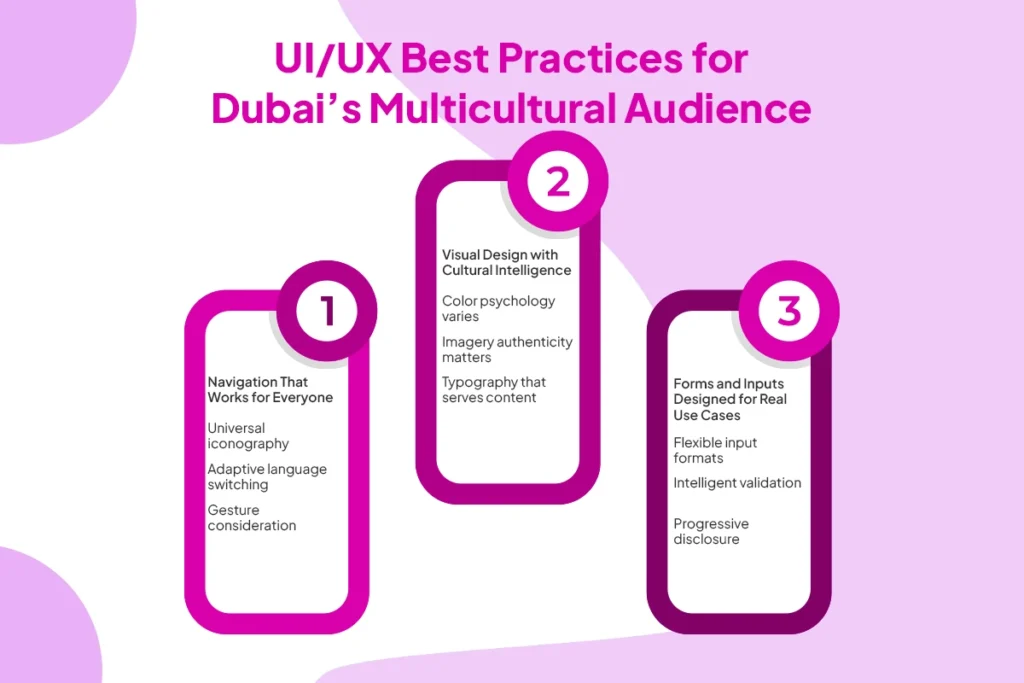
UI/UX Best Practices for Dubai’s Multicultural Audience

UI/UX Best Practices for Dubai’s Multicultural Audience

Navigation That Works for Everyone

Balance universal design with local adaptations:

  • Universal iconography: Use icons like a shopping cart or heart that communicate across cultures.
  • Adaptive language switching: Implement a persistent language selector, standardly placed in the top right corner.
  • Gesture consideration: Test swipe gestures with diverse users; a right-to-left swipe can have different meanings.

Visual Design with Cultural Intelligence

  • Color psychology varies: Conduct research with target segments. Blue may mean trust in the West but something else in South Asia.
  • Imagery authenticity matters: Invest in custom visuals reflecting Dubai’s actual diversity in age, ethnicity, and dress.
  • Typography that serves content: Arabic script requires specific consideration for letter connections, line heights, and spacing.

Forms and Inputs Designed for Real Use Cases

Optimize for Dubai’s specific needs:

  • Flexible input formats: Accommodate different phone numbers, name structures, and address systems.
  • Intelligent validation: Provide clear, helpful error messages. Use real-time validation to catch issues early.
  • Progressive disclosure: Break complex processes into manageable steps with clear progress indicators.

The 2026 UX Trends Shaping Mobile App Design in Dubai

1. Voice-First and Multimodal Interfaces

  • Multilingual voice support must handle code-switching (mixing languages in one query) gracefully.
  • Context-aware responses should consider location, time, and user history.
  • Visual voice feedback provides clear confirmation of what was understood and the action taken.

2. AI-Driven Personalization at Scale

  • Predictive assistance anticipates needs, a food app suggesting favorite restaurants at lunchtime.
  • Adaptive interfaces adjust layout and content prioritization based on individual usage patterns.
  • Intelligent defaults set smart preferences for location and language based on demographics.

3. Augmented Reality for Enhanced Utility

  • Retail visualization allows users to see furniture in their home or clothing fit before purchase.
  • Navigation enhancement overlays directions in large malls or complex developments.
  • Educational applications provide interactive information about landmarks through the camera view.

4. Emotional Design and Micro-Interactions

  • Purposeful animations communicate status, guide attention, or provide feedback.
  • Haptic feedback integration confirms actions, indicates errors, or enhances immersion.
  • Celebratory moments recognize user achievements with appropriate visual or interactive rewards.

Common UX Mistakes to Avoid in the UAE Market

  • Mistake 1: Assuming English-Only Suffices
    • The Fix: Launch with bilingual (English/Arabic) support from day one, ensuring core functionality works in both.
  • Mistake 2: Treating RTL as an Afterthought
    • The Fix: Design RTL interfaces natively, considering how eye movement and reading patterns differ.
  • Mistake 3: Underestimating Performance Expectations
    • The Fix: Test on local networks (Etisalat and du) throughout development. Optimize images and implement caching.
  • Mistake 4: Overcomplicating the Interface
    • The Fix: Prioritize core features. Use progressive disclosure and conduct usability testing to eliminate complexity.
  • Mistake 5: Ignoring Local Payment Preferences
    • The Fix: Integrate UAE-specific payment gateways (like Telr) alongside global options to boost conversion.
  • Mistake 6: Using Generic Visual Content
    • The Fix: Invest in authentic visuals representing Dubai’s diversity. Curated Middle Eastern stock is better than generic alternatives.

Book a Free UX Audit

30-minute audit with Dubai experts.

Real-World Insight: Localizing Luxury in Dubai

Consider the challenge faced by a Dubai-based luxury tailoring house. Their clientele, high-net-worth individuals accustomed to premium service, expected a digital experience that mirrored their in-store bespoke service. Their initial website failed to convert because it used generic imagery and a cumbersome booking flow.

The UX solution was hyper-localized and user-centered:

  • Cultural Visual Hierarchy: The design was rebuilt as visual-first, using high-quality imagery of finished garments in local settings (luxury hotels, weddings) that resonated with the target audience’s lifestyle.
  • Streamlined, Trust-Centric Conversion: A “Book a Private Appointment” engine was integrated, reducing a multi-page inquiry form to three simple steps. Prominent placement of trust signals (client testimonials, awards) addressed the high-consideration nature of the purchase.
  • Technical Performance for Premium Users: The site was optimized for speed, understanding that their audience uses high-end devices and has zero tolerance for lag, even when browsing high-resolution image galleries.

The outcome was a digital storefront that felt authentically Dubai, resulting in a measurable increase in qualified appointment bookings and establishing a stronger digital brand presence. This example illustrates that for Dubai’s discerning users, UX is the silent ambassador of your brand’s quality and a critical component of Dubai app development trends.

Evaluating UX Expertise for Your Dubai App Project

Choosing the right UX approach can make or break your product’s success. Whether you’re building an in-house team or partnering with a premium mobile app development company, like DigiDesire in Dubai, the goal is the same: delivering smooth, user-first experiences. The key is to ensure these essential UX capabilities are fully covered, so your app not only looks great but also works effortlessly for your users.

Local Market and Behavioral Intelligence

The team must understand subtle nuances: which design patterns resonate with different demographics, which features are expected based on competitor offerings, and how to navigate the unique aspects of UAE digital culture. For instance, they should know that a “guest checkout” option can significantly reduce abandonment in a market wary of lengthy sign-ups.

Regulatory Navigation and Compliance

The UAE’s digital landscape includes specific regulations around data privacy (PDPL), content, and accessibility. The responsible team must proactively ensure your app’s UX complies while maintaining a seamless experience, turning compliance into a trust-building feature rather than a constraint.

Access to Real User Testing and Validation

Effective UX requires testing with participants who reflect your actual target audience. The right team can recruit appropriate testers, conduct sessions in relevant languages, and, most importantly, interpret feedback through a local cultural lens to uncover true insights, not just surface-level opinions.

Commitment to Ongoing, Localized Optimization

Post-launch, continuous improvement is vital. The team should monitor how real users in the UAE interact with your app, identify context-specific pain points (e.g., drop-offs during Arabic checkout), and implement targeted enhancements that drive engagement and retention in this market.

A Step-by-Step UX Design Framework for Dubai Apps

A Step-by-Step UX Design Framework for Dubai Apps

Phase 1: Discovery and Research

  • Understand the “why” behind user behavior in the Dubai context.
  • Conduct contextual interviews in users’ actual environments.
  • Analyze competitor execution for Dubai users, not just their features.
  • Create detailed personas reflecting Dubai’s diversity in nationality, language, and digital behavior.

Phase 2: Strategy Definition

  • Translate research into an actionable plan.
  • Map comprehensive user journeys, noting cultural and contextual factors at each stage.
  • Establish Dubai-specific UX goals (e.g., Arabic interface adoption rate).
  • Develop detailed content and localization plans.

Phase 3: Design and Prototyping

  • Create solutions balancing universal usability with local relevance.
  • Develop bilingual wireframes from the earliest stages.
  • Design flexible visual systems accommodating cultural variations.
  • Build interactive prototypes to test RTL navigation or multilingual search.

Phase 4: Testing and Refinement

  • Validate with actual Dubai users.
  • Conduct culturally-aware usability tests in participants’ preferred languages.
  • Test under realistic conditions: local networks, various lighting, and typical usage contexts.
  • Iterate based on nuanced feedback, considering cultural influences on responses.

Phase 5: Launch and Continuous Learning

  • The launch is the beginning.
  • Implement analytics tracking Dubai-specific behaviors (language switching, feature usage by segment).
  • Establish multilingual feedback channels.
  • Use real-world data to prioritize improvements with the greatest local impact.

UX as Your Competitive Advantage in Dubai

In Dubai’s crowded app marketplace, superior UX is your most powerful differentiator. An app that feels made for Dubai, that understands its people and delights them at every touchpoint, doesn’t just acquire users, it retains them.

As we move through 2026, the lines between technology and humanity will blur further. The winners will design not just for screens, but for people. If you are looking to navigate this landscape, partnering with experts like DigiDesire ensures your app meets international standards while catering to the specific needs of this unique market.

Build Your Dubai App with Digidesire

Partner with Dubai UX specialists.

FAQs

Assuming one design works for all. Dubai's audience is highly segmented. Successful apps offer flexible, localized, and personalized experiences that users can tailor to their cultural context.
Critical. Even if users speak English, offering Arabic shows cultural respect and can significantly increase trust and engagement. Research indicates Arabic interfaces can boost conversion by up to 40% among Arabic-dominant users.
Right-to-left (RTL) layout for Arabic. It affects navigation, alignment, reading patterns, and animation. Proper implementation requires rethinking entire interaction models, not just mirroring left-to-right designs.
Use local testing panels, partner with a Dubai-based agency for user testing sessions, and conduct A/B testing with targeted segments. Methods like diary studies capture how users interact with your app in their daily lives.
Yes. With high adoption of smart assistants, integrating voice commands, especially in Arabic, is a key differentiator. It's valuable where manual interaction is difficult, like while driving or where manual interaction is difficult, like while driving.