
Key Takeaways
Have you ever had a brilliant idea strike you in the middle of the night, an idea for an app that solves a real problem? You grab your phone, jot it down, and then pause. What happens next? How do you actually turn that scribbled note into a downloadable application on someone’s phone? Building an app isn’t magic; it is a structured engineering journey. Whether you are a startup founder looking to disrupt the market or an enterprise looking to streamline operations, understanding the services offered by a development company in Dubai like DigiDesire is the first step toward success.
Many people believe that development is just about writing code. In reality, coding is only about 30% of the work. The rest involves strategy, design, psychological analysis of users, testing, and marketing. This guide will walk you through the entire lifecycle, ensuring you don’t just build an app, but a product that users love and retain.
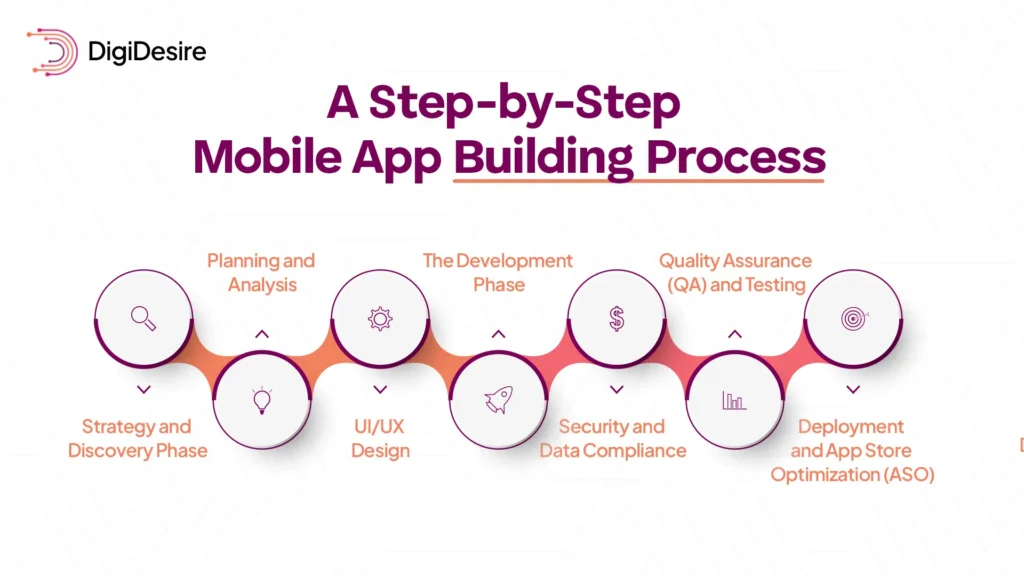
Before a single line of code is written, the foundation must be laid. The biggest mistake entrepreneurs make is rushing into development without a solid plan. The first stage of the app building process is purely strategic. This phase determines why you are building the app and who you are building it for.
You need to validate your idea objectively. Just because you like the idea doesn’t mean the market needs it. You must conduct thorough competitor analysis. Who are your competitors? What are they doing right? More importantly, what are they doing wrong?
Finding a gap in the market is your golden ticket. For instance, if you are targeting a specific region, reading a Comprehensive Guide to Mobile App Development in Dubai can offer localized insights into consumer behavior, regulatory requirements, and cultural preferences that might differ significantly from Western markets.
Who is your ideal user? You should create detailed “User Personas.”
How will your app generate revenue? Deciding this early influences the design and flow of the app.
Defining your app monetization strategy early is critical. If you plan to use subscriptions, you need to integrate complex recurring billing systems like Stripe or Apple Pay right from the start.
Once the idea is validated, we move to the blueprint phase. This is where the abstract idea turns into a concrete plan. This is where the steps to creating an app become technical and logistical.
A roadmap is a strategic document that maps out the direction of your product. It outlines short-term and long-term goals. You might start with an MVP (Minimum Viable Product) and plan to add AI features in Phase 2.
You cannot build a great app alone. Even if you are outsourcing, you should know who is handling your project. A standard app development team includes:
If you are outsourcing, knowing how to choose the right digital marketing agency in Dubai (or app partner) is critical. You need a partner who provides this full spectrum of talent, not just a freelance coder.
How will the team work?
Most modern teams use the Agile approach because it allows for changes during the process of developing an app. If you realize a feature isn’t working, you can change it in the next sprint without derailing the whole project.
An app needs to be intuitive. If a user can’t figure out how to use your app in the first few seconds, they will uninstall it. The app design and development process are deeply intertwined here.
Wireframes are low-fidelity sketches of the app. They don’t have colors or images; they just show the layout. They answer questions like: “Where does the ‘Sign Up’ button go?” and ” what happens when I click this icon?”
UX focuses on the feel and the flow. It ensures the user achieves their goal with the minimum number of steps. Implementing User Experience (UX) Design in Mobile Apps: Best Practices for Dubai’s Diverse Audience ensures that your interface respects local usability standards. For example, in some regions, Arabic language support (Right-to-Left layout) is mandatory, which fundamentally changes the design structure.
This is where the app comes to life visually. Designers add colors, brand logos, fonts, and animations. The output of this phase is a “High-Fidelity Prototype”, a clickable version of the design that looks like the real app but doesn’t have code behind it yet.
This is the “meat” of the process of mobile app development. This is where the actual coding happens. It is usually divided into three distinct parts that run in parallel.
The backend is the brain of the app, often built using the services offered by a web development company in Dubai to manage databases securely.
An API (Application Programming Interface) is the bridge that allows your app to talk to the backend or third-party services.
This is the part of the app the user touches and sees. There are two main ways to build this:
Deciding between these approaches is a major strategic choice best navigated with a professional mobile app development company in Dubai. Choosing the Right Platform: iOS vs. Android Development in the UAE to understand which approach fits your budget and target market.
During this phase, keeping an eye on the Top 10 Mobile App Development Trends in Dubai: What’s Hot in 2026 can give you a competitive edge. For instance, integrating AI-driven chatbots or Augmented Reality (AR) features is becoming standard for retail and real estate apps.
In 2026, security is not an option; it is a requirement. With cyber threats on the rise, your app development workflow must include security protocols from day one.
Ignoring security can lead to data breaches that destroy your brand’s reputation instantly.
Never launch an app without rigorous testing. The stages of mobile app development must always include a dedicated QA phase.
Before the public launch, release the app to a small group of external users (Beta Testers). They will find bugs that your internal team missed. This feedback loop is essential for a polished final product.
Your app is built, tested, and secure. Now, it’s time to show it to the world. But simply uploading it isn’t enough.
Google Play Store and Apple App Store have strict guidelines.
Just like SEO helps websites rank on Google, ASO helps your app rank on the App Store.
A solid ASO strategy ensures that when users search for a solution, your app appears at the top.
The mobile app development process steps don’t end when the app is live. In fact, the real work starts here. An app is a living product that needs care.
You need to integrate tools like Google Analytics for Firebase or Mixpanel. These tools tell you:
Mobile operating systems (iOS and Android) update annually. If you don’t update your app, it will eventually stop working on new phones. Furthermore, you need to release updates to fix bugs and introduce new features based on user feedback.
Maintenance costs money. When budgeting, it is essential to focus on mastering social media marketing ROI in Dubai and understanding long-term maintenance costs. Industry standards suggest budgeting 15-20% of the initial development cost annually for maintenance.
Even with a good plan, many projects fail. Here are common mistakes to watch out for:
As technology evolves, so does the process. We are moving towards more AI-driven development, where AI writes boilerplate code, speeding up the process. Low-code and no-code platforms are also rising, though they have limitations for complex custom apps. Keeping an eye on the Future of Mobile App Development: Innovations to Watch (Beyond 2026) will help you future-proof your application, ensuring it remains relevant for years to come.
The journey from a napkin scribble to a live app on the App Store is complex but rewarding. It requires a blend of creative vision, strategic planning, and engineering excellence. By following this structured mobile app development process, you minimize risks and maximize the chances of your app becoming a market success.
If you are looking for a partner to guide you through this journey, working with DigiDesire can help you navigate these complexities. Their expertise ensures your app meets international standards while catering to the specific needs of your target audience.



Damac Executive Heights - 19th Floor Al Khareef 1 St - Al Thanyah First - Barsha Heights - Dubai
133 5th Ave S, Shelby, Montana 59474, United States
Damac Executive Heights - 19th Floor Al Khareef 1 St - Al Thanyah First - Barsha Heights - Dubai
Melbourne CBD 440 Collins St, Melbourne VIC 3000, Australia
Office # 701, 7th Floor, Razi Tower, BC-13, Block 9, Clifton, Karachi.


