Imagine you are walking through the massive Mohammed Bin Rashid Library in Dubai. You are looking for a specific book on sustainable architecture. Without a digital catalog or a helpful librarian, you would spend weeks wandering through aisles. The internet is billions of times larger than that library, and search engines are the librarians that keep it from turning into total chaos. To understand how search engines work, you have to look past the simple search bar we use every day. Whether you are a business owner looking for a reliable partner like DigiDesire, a leading SEO agency in Dubai, or a marketing student in Sharjah, knowing the mechanics behind the ‘Search’ button is crucial.
Search engines don’t actually search the “live” web when you type a query. Instead, they search a massive database of pages they have already discovered and organized. This process happens in three distinct stages: Crawling, Indexing, and Ranking.
Before a search engine can show you a website, it has to know it exists. Crawling is the discovery stage where search engines send out a team of robots (known as crawlers or spiders) to find new and updated content.
Think of crawlers as digital explorers. They start with a list of web addresses from past crawls and sitemaps provided by website owners. As they visit these websites, they use links on those pages to find other pages.
For example, if a popular news portal in Dubai links to your new cafe’s website, Google’s crawler (Googlebot) will follow that “path” to find you. This is why internal and external linking is so important. If a page has no links pointing to it, a crawler might never find it. It becomes an “orphan page,” effectively invisible to the world.
Search engines don’t have infinite resources. They assign a crawl budget to every website, a limit on how many pages the spider will look at during a single visit. For a small boutique in Jumeirah, this isn’t usually an issue. However, for large e-commerce sites with thousands of product variations, ensuring that the most important pages are crawled efficiently is a vital part of technical maintenance.
Once a crawler finds a page, the search engine tries to understand what the page is about. This stage is called indexing.
During indexing, the search engine analyzes the content, images, and video files on the page. It stores this information in a humongous database called the web page index. If a page is in the index, it is eligible to be shown to users.
Think of the index as the “Search Engine’s Brain.” It stores the text of the page, the location of the page (URL), and metadata that describes the content.
Not every crawled page gets indexed. A search engine might skip a page if:
While the general concept of how search engines work remains the same across platforms, there are slight differences. Google crawling and indexing is incredibly fast and prioritizes mobile-friendliness. The difference between Google and Bing often lies in how they value social signals and multimedia; Bing is known to be slightly more transparent about its indexing of Flash or large image files, though Google remains the dominant force in speed and accuracy.
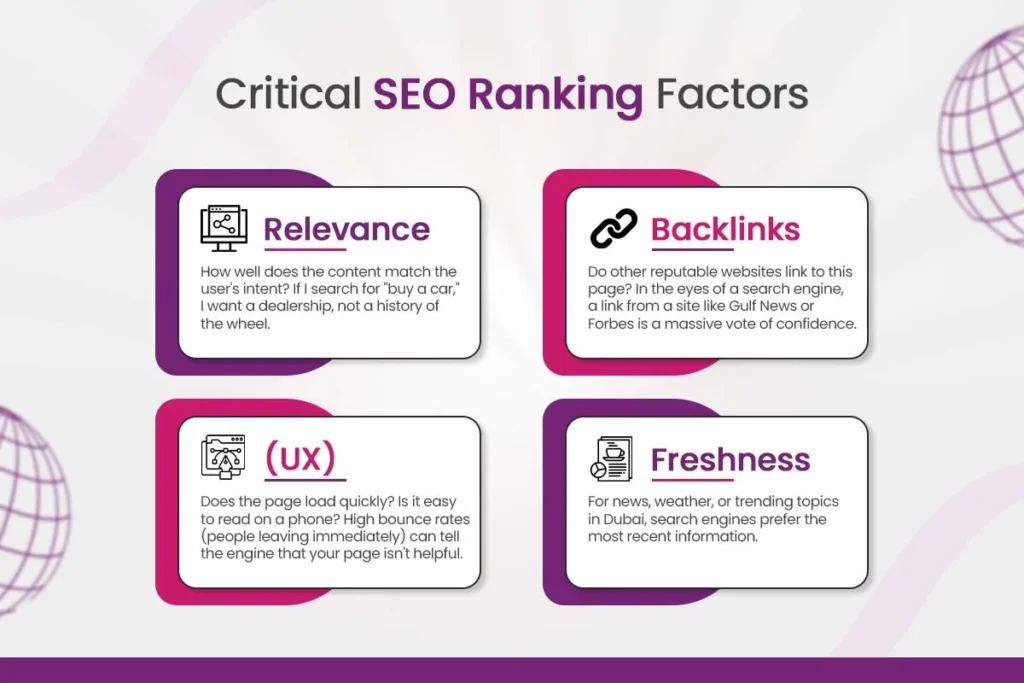
This is the part we all see. When you type “best specialty coffee in Al Quoz” into a search bar, the ranking algorithm takes over. Out of the millions of pages, the engine decides relevance, which is the core of how SEO services help you rank in Dubai effectively.
Search engines use hundreds of signals to determine rank. While the exact formulas are secret, we know several key SEO ranking factors that influence the results:
Google specifically looks for E-E-A-T (Experience, Expertise, Authoritativeness, and Trustworthiness). This is particularly important for “Your Money or Your Life” (YMYL) topics like health or finance.
If you are writing about the latest VAT laws in the UAE, the search engine wants to see that the author has the expertise to talk about it. Providing high-quality, verified information with citations to government sources is the best way to build this trust.
In the early days of search engine basics, ranking was mostly about “keyword matching.” If you used the word “Dubai Hotel” 50 times, you would rank. Today, engines use Semantic Search.
They understand context. If you search for “Apple,” the engine looks at your previous searches to see if you are interested in the fruit or the latest iPhone. Understanding how search engines operate means realizing they are trying to think like humans. They look for synonyms, related topics, and the “why” behind your search.
Even the best content can fail if the technical foundation is weak. Here are some common ‘blockers’ that a comprehensive SEO strategy for businesses in Dubai must address to let search engines do their job:
While we all want to rank at the top, taking shortcuts can lead to google penalties. These are “punishments” handed out to websites that try to trick the search engine.
Common reasons for penalties include:
A penalty can cause your website to drop significantly in rankings or, in extreme cases, be removed from the index entirely. It is always better to build a site for humans first and search engines second.

If you are running a business in Dubai, you’ve likely noticed that your search results look different when you are in Deira versus when you are in Dubai Marina. This is because of Geographic Localization.
Search engines detect your IP address or GPS data to provide the most helpful local results. This is a subset of search engine basics known as Local SEO. For businesses, this means ensuring your physical address and contact details are consistent across the web (NAP: Name, Address, Phone) so the “librarian” knows exactly where to send the “reader.”
As we move forward, the landscape of AI in digital marketing is evolving how search engines work. Google’s Search Generative Experience (SGE) and Bing’s AI chat are changing how results are displayed. Instead of just a list of links, search engines are now providing direct summaries.
To stay relevant in this new era, your content must be even more comprehensive. It’s no longer enough to just answer a question; you must provide a perspective or ‘Experience’ (the new ‘E’ in E-E-A-T) that an AI cannot easily replicate, a standard we uphold at DigiDesire.



Damac Executive Heights - 19th Floor Al Khareef 1 St - Al Thanyah First - Barsha Heights - Dubai
133 5th Ave S, Shelby, Montana 59474, United States
Office # 701, 7th Floor, Razi Tower, BC-13, Block 9, Clifton, Karachi.
Damac Executive Heights - 19th Floor Al Khareef 1 St - Al Thanyah First - Barsha Heights - Dubai
Melbourne CBD 440 Collins St, Melbourne VIC 3000, Australia
Office # 701, 7th Floor, Razi Tower, BC-13, Block 9, Clifton, Karachi.


